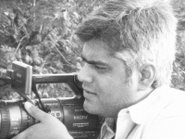
Photo via Grazia Magazine.
Over the course of 45 years in the film business, Francis Ford Coppola has refined a singular code of ethics that govern his filmmaking. There are three rules: 1) Write and direct original screenplays, 2) make them with the most modern technology available, and 3) self-finance them. But Coppola didn’t develop this formula overnight. Though he found Hollywood success at the young age of 30, he admits that the early “Godfather” fame pulled him off course from his dream of writing and directing personal stories. Like Bergman, Coppola wanted to wake up and make movies based on his dreams and nightmares.
Thanks in no small part to his booming wine business, Coppola now does just that. He recently wrapped his latest picture, “Twixt Now and Sunrise,” based on an alcohol-induced dream he had in Turkey. The film even features the latest 3-D technology – but as a brief dramatic segment that serves the story, rather than the typical two-hour, multiplex gimmick.
I sat down with Mr. Coppola at La Mamounia, the legendary Moroccan palace-turned-hotel, during the Marrakech International Film Festival, where he shared insights on the filmmaking craft with local students. Rejecting the popular “master class” format, Coppola preferred a simple “conversation,” where he spoke candidly with students and shared his advice generously. What follows are excerpts from both conversations.
Why did you choose not to teach a master class?
For me in cinema there are few masters. I have met some masters – Kurosawa, Polanski – but I am a student.
I just finished a film a few days ago, and I came home and said I learned so much today. So if I can come home from working on a little film after doing it for 45 years and say, “I learned so much today,” that shows something about the cinema. Because the cinema is very young. It’s only 100 years old.
Even in the early days of the movies, they didn’t know how to make movies. They had an image and it moved and the audience loved it. You saw a train coming into the station, and just to see motion was beautiful.
The cinema language happened by experimentation – by people not knowing what to do. But unfortunately, after 15-20 years, it became a commercial industry. People made money in the cinema, and then they began to say to the pioneers, “Don’t experiment. We want to make money. We don’t want to take chances.”
The cinema language happened by experimentation – by people not knowing what to do.
An essential element of any art is risk. If you don’t take a risk then how are you going to make something really beautiful, that hasn’t been seen before? I always like to say that cinema without risk is like having no sex and expecting to have a baby. You have to take a risk.
You try to go to a producer today and say you want to make a film that hasn’t been made before; they will throw you out because they want the same film that works, that makes money. That tells me that although the cinema in the next 100 years is going to change a lot, it will slow down because they don’t want you to risk anymore. They don’t want you to take chances. So I feel like [I’m] part of the cinema as it was 100 years ago, when you didn't know how to make it. You have to discover how to make it.
You try to go to a producer today and say you want to make a film that hasn’t been made before; they will throw you out because they want the same film that works, that makes money. That tells me that although the cinema in the next 100 years is going to change a lot, it will slow down because they don’t want you to risk anymore. They don’t want you to take chances. So I feel like [I’m] part of the cinema as it was 100 years ago, when you didn't know how to make it. You have to discover how to make it.

Gene Hackman in The Conversation.
Do you feel like you’re more of a risk-taker now?
I was always a good adventurer. I was never afraid of risks. I always had a good philosophy about risks. The only risk is to waste your life, so that when you die, you say, “Oh, I wish I had done this.” I did everything I wanted to do, and I continue to.
What’s the most useful piece of advice you’d give a student?
The first thing you do when you take a piece of paper is always put the date on it, the month, the day, and where it is. Because every idea that you put on paper is useful to you. By putting the date on it as a habit, when you look for what you wrote down in your notes, you will be desperate to know that it happened in April in 1972 and it was in Paris and already it begins to be useful. One of the most important tools that a filmmaker has are his/her notes.
I was always a good adventurer. I was never afraid of risks. I always had a good philosophy about risks. The only risk is to waste your life, so that when you die, you say, “Oh, I wish I had done this.” I did everything I wanted to do, and I continue to.
What’s the most useful piece of advice you’d give a student?
The first thing you do when you take a piece of paper is always put the date on it, the month, the day, and where it is. Because every idea that you put on paper is useful to you. By putting the date on it as a habit, when you look for what you wrote down in your notes, you will be desperate to know that it happened in April in 1972 and it was in Paris and already it begins to be useful. One of the most important tools that a filmmaker has are his/her notes.
If you don’t take a risk then how are you going to make something really beautiful, that hasn’t been seen before?
Is it important to veer away from the masters to develop one’s own style?
I once found a little excerpt from Balzac. He speaks about a young writer who stole some of his prose. The thing that almost made me weep, he said, “I was so happy when this young person took from me.” Because that’s what we want. We want you to take from us. We want you, at first, to steal from us, because you can’t steal. You will take what we give you and you will put it in your own voice and that’s how you will find your voice.
And that’s how you begin. And then one day someone will steal from you. And Balzac said that in his book: It makes me so happy because it makes me immortal because I know that 200 years from now there will be people doing things that somehow I am part of. So the answer to your question is: Don’t worry about whether it’s appropriate to borrow or to take or do something like someone you admire because that’s only the first step and you have to take the first step.
How does an aspiring artist bridge the gap between distribution and commerce?
We have to be very clever about those things. You have to remember that it’s only a few hundred years, if that much, that artists are working with money. Artists never got money. Artists had a patron, either the leader of the state or the duke of Weimar or somewhere, or the church, the pope. Or they had another job. I have another job. I make films. No one tells me what to do. But I make the money in the wine industry. You work another job and get up at five in the morning and write your script.
This idea of Metallica or some rock n’ roll singer being rich, that’s not necessarily going to happen anymore. Because, as we enter into a new age, maybe art will be free. Maybe the students are right. They should be able to download music and movies. I’m going to be shot for saying this. But who said art has to cost money? And therefore, who says artists have to make money?
In the old days, 200 years ago, if you were a composer, the only way you could make money was to travel with the orchestra and be the conductor, because then you’d be paid as a musician. There was no recording. There were no record royalties. So I would say, “Try to disconnect the idea of cinema with the idea of making a living and money.” Because there are ways around it.
I once found a little excerpt from Balzac. He speaks about a young writer who stole some of his prose. The thing that almost made me weep, he said, “I was so happy when this young person took from me.” Because that’s what we want. We want you to take from us. We want you, at first, to steal from us, because you can’t steal. You will take what we give you and you will put it in your own voice and that’s how you will find your voice.
And that’s how you begin. And then one day someone will steal from you. And Balzac said that in his book: It makes me so happy because it makes me immortal because I know that 200 years from now there will be people doing things that somehow I am part of. So the answer to your question is: Don’t worry about whether it’s appropriate to borrow or to take or do something like someone you admire because that’s only the first step and you have to take the first step.
How does an aspiring artist bridge the gap between distribution and commerce?
We have to be very clever about those things. You have to remember that it’s only a few hundred years, if that much, that artists are working with money. Artists never got money. Artists had a patron, either the leader of the state or the duke of Weimar or somewhere, or the church, the pope. Or they had another job. I have another job. I make films. No one tells me what to do. But I make the money in the wine industry. You work another job and get up at five in the morning and write your script.
This idea of Metallica or some rock n’ roll singer being rich, that’s not necessarily going to happen anymore. Because, as we enter into a new age, maybe art will be free. Maybe the students are right. They should be able to download music and movies. I’m going to be shot for saying this. But who said art has to cost money? And therefore, who says artists have to make money?
In the old days, 200 years ago, if you were a composer, the only way you could make money was to travel with the orchestra and be the conductor, because then you’d be paid as a musician. There was no recording. There were no record royalties. So I would say, “Try to disconnect the idea of cinema with the idea of making a living and money.” Because there are ways around it.
You have to remember that it’s only a few hundred years, if that much, that artists are working with money.
What’s the greatest challenge of a screenwriter?
A screenplay has to be like a haiku. It has to be very concise and very clear, minimal. When you go to make it as a film, you have the suggestions of the actors, which are going to be available to you, right? You’re going to listen to the actors because they have great ideas. You’re going to listen to the photographer because he will have a great idea.
A screenplay has to be like a haiku. It has to be very concise and very clear, minimal. When you go to make it as a film, you have the suggestions of the actors, which are going to be available to you, right? You’re going to listen to the actors because they have great ideas. You’re going to listen to the photographer because he will have a great idea.
You must never be the kind of director, I think maybe I was when I was 18, “No, no, no, I know best.” That’s not good. You can make the decision that you feel is best, but listen to everyone, because cinema is collaboration. I always like to say that collaboration is the sex of art because you take from everyone you’re working with.
What is the one thing to keep in mind when making a film?
When you make a movie, always try to discover what the theme of the movie is in one or two words. Every time I made a film, I always knew what I thought the theme was, the core, in one word. In “The Godfather,” it was succession. In “The Conversation,” it was privacy. In “Apocalypse,” it was morality.
The reason it’s important to have this is because most of the time what a director really does is make decisions. All day long: Do you want it to be long hair or short hair? Do you want a dress or pants? Do you want a beard or no beard? There are many times when you don’t know the answer. Knowing what the theme is always helps you.
When you make a movie, always try to discover what the theme of the movie is in one or two words. Every time I made a film, I always knew what I thought the theme was, the core, in one word. In “The Godfather,” it was succession. In “The Conversation,” it was privacy. In “Apocalypse,” it was morality.
The reason it’s important to have this is because most of the time what a director really does is make decisions. All day long: Do you want it to be long hair or short hair? Do you want a dress or pants? Do you want a beard or no beard? There are many times when you don’t know the answer. Knowing what the theme is always helps you.
I remember in “The Conversation,” they brought all these coats to me, and they said: Do you want him to look like a detective, Humphrey Bogart? Do you want him to look like a blah blah blah. I didn’t know, and said the theme is ‘privacy’ and chose the plastic coat you could see through. So knowing the theme helps you make a decision when you’re not sure which way to go.

Marlon Brando in The Godfather.
What’s the secret to working with great actors?
I’m going to tell you the story of how I prepared the actors of “The Godfather.” Of course, we were all nervous about Marlon Brando. As theatre students in the ‘50s, we looked at him as the greatest. And there was going to be the first time when all the actors were going to meet. Of course, Al Pacino, Jimmy Caan, Bobby Duvall, Johnny Cazale – everyone just admired Marlon. He was the Godfather. I knew that, and I said, “I can use this.” Napoleon once said, “Use the weapons at hand,” and this is what a film director has to do everyday. So what I did is I arranged for the first meeting as an improvisation.
I said, “I want you to come and be hungry.” And they came to a restaurant that I had arranged, the back room of the restaurant, just a table that looked like a home. Marlon, I had sit at the head of the table, and to his right I put Al Pacino, and to his left I put Jimmy Caan. I put Bobby Duvall, and I put Johnny Cazale, and I had my sister Talia, who played Connie, serve the food.
They had a dinner improvisation together, and after awhile everyone is relating to Marlon as the father, and Jimmy Caan is trying to impress him with jokes, and Al Pacino is trying to impress him by being intense and quiet, and my sister was so frightened – she was serving the food. And after that dinner they were the characters. So one tip I give you is, with improvisations, they really stick if there’s something sensual connected with them, like food or eating or making something with their hands.
I’m going to tell you the story of how I prepared the actors of “The Godfather.” Of course, we were all nervous about Marlon Brando. As theatre students in the ‘50s, we looked at him as the greatest. And there was going to be the first time when all the actors were going to meet. Of course, Al Pacino, Jimmy Caan, Bobby Duvall, Johnny Cazale – everyone just admired Marlon. He was the Godfather. I knew that, and I said, “I can use this.” Napoleon once said, “Use the weapons at hand,” and this is what a film director has to do everyday. So what I did is I arranged for the first meeting as an improvisation.
I said, “I want you to come and be hungry.” And they came to a restaurant that I had arranged, the back room of the restaurant, just a table that looked like a home. Marlon, I had sit at the head of the table, and to his right I put Al Pacino, and to his left I put Jimmy Caan. I put Bobby Duvall, and I put Johnny Cazale, and I had my sister Talia, who played Connie, serve the food.
They had a dinner improvisation together, and after awhile everyone is relating to Marlon as the father, and Jimmy Caan is trying to impress him with jokes, and Al Pacino is trying to impress him by being intense and quiet, and my sister was so frightened – she was serving the food. And after that dinner they were the characters. So one tip I give you is, with improvisations, they really stick if there’s something sensual connected with them, like food or eating or making something with their hands.
Napoleon once said, ‘Use the weapons at hand,’ and this is what a film director has to do everyday.
How do you adapt a novel into a script?
Well, usually it’s the novel that’s adapted. The novel, unfortunately, is not a good form to adapt to film because the question of the novel is it’s usually much, much, much too long with too many characters, too many parts. The short story is the natural narrative, linear narrative to become a film. Many, many short stories have become films.
With a novel, what I can recommend is when you first read the novel, put good notes in it the first time, right on the book, write down everything you feel, underline every sensation that you felt was strong. Those first notes are very valuable. Then, when you finish the book, you will see that some pages are filled with underlined notes and some are blank.
In theatre, there’s something called a prompt book. The prompt book is what the stage manager has, usually a loose-leaf book with all the lighting cues. I make a prompt book out of the novel. In other words, I break the novel, and I glue the pages in a loose-leaf, usually with the square cutout so I can see both sides.
I have that big book with the notes I took, and then I go and I put lots more observations and notes. Then I begin to go through that and summarize the part that I thought was useful. And quite naturally you’ll see that the parts fall away, or that you have too many characters, so you know that you have to eliminate some or combine some. Working on it this way, from the outside in, being more specific as to what you think… then when you finish that, you are qualified perhaps to try to write a draft based on that notebook.
In the case of “The Godfather” I did that, and although I had a screenplay, I never used it. I always used to take that big notebook around with me, and I made the movie from that notebook. In the case of “Apocalypse,” there was a script written by the great John Milius, but, I must say, what I really made the film from was the little green copy of Heart of Darkness that I had done all those lines in. Whenever I would do a scene, I would check that and see what can I give the movie from Conrad.
Well, usually it’s the novel that’s adapted. The novel, unfortunately, is not a good form to adapt to film because the question of the novel is it’s usually much, much, much too long with too many characters, too many parts. The short story is the natural narrative, linear narrative to become a film. Many, many short stories have become films.
With a novel, what I can recommend is when you first read the novel, put good notes in it the first time, right on the book, write down everything you feel, underline every sensation that you felt was strong. Those first notes are very valuable. Then, when you finish the book, you will see that some pages are filled with underlined notes and some are blank.
In theatre, there’s something called a prompt book. The prompt book is what the stage manager has, usually a loose-leaf book with all the lighting cues. I make a prompt book out of the novel. In other words, I break the novel, and I glue the pages in a loose-leaf, usually with the square cutout so I can see both sides.
I have that big book with the notes I took, and then I go and I put lots more observations and notes. Then I begin to go through that and summarize the part that I thought was useful. And quite naturally you’ll see that the parts fall away, or that you have too many characters, so you know that you have to eliminate some or combine some. Working on it this way, from the outside in, being more specific as to what you think… then when you finish that, you are qualified perhaps to try to write a draft based on that notebook.
In the case of “The Godfather” I did that, and although I had a screenplay, I never used it. I always used to take that big notebook around with me, and I made the movie from that notebook. In the case of “Apocalypse,” there was a script written by the great John Milius, but, I must say, what I really made the film from was the little green copy of Heart of Darkness that I had done all those lines in. Whenever I would do a scene, I would check that and see what can I give the movie from Conrad.

Martin Sheen in Apocalypse Now.
What’s the best piece of advice you’ve given to your children, inside and outside of the industry?
Always make your work be personal.
And, you never have to lie. If you lie, you will only trip yourself up. You will always get caught in a lie. It is very important for an artist not to lie, and most important is not to lie to yourself. There are some questions that are inappropriate to ask, and rather than lie, I will not answer them because it’s not a question I accept. So many times we are asked things in our work or in life that you want to lie, and all you have to do is say, “No, that is an improper question.”
So when you get into a habit of not lying when you are writing, directing, or making a film, that will carry your personal conviction into your work. And, in a society where you say you are very free but you’re not entirely free, you have to try. There is something we know that’s connected with beauty and truth. There is something ancient. We know that art is about beauty, and therefore it has to be about truth.
You now have all the resources to do your own production, writing, directing. What’s the biggest barrier to being an artist?
Self-confidence always. The artist always battles his own/her own feeling of inadequacy.
How do you overcome that?
I’ve learned an interesting thing. When I was young on a movie set, I would try to stage the scene and the actors would read it, and I said, “Well, you stand here and you sit there, and blah, blah, blah.” They would say, “Well, I don’t think I should sit there, I should stand there. And I don’t think this line is right.” And they would begin to challenge the text.
What I learned, which is a simple idea, is that if you hold out with your vision a little bit, it’s like a cake being put in the oven. The scene doesn’t work immediately, you have to bake it a little bit. It’s unfair, when you begin to create a shot, say, or a scene, that it’s going to immediately be like those beautiful scenes in the movies. It needs a little bit of time to mature. It’s like taking the cake out without letting it be in the oven for more than a minute. Like, oh no, it’s terrible. So you have to be patient, and then slowly everyone starts to see that the ideas are right, or make the corrections. You have to battle the lack of confidence by giving the scene the chance to solidify.
Do you use that approach in life as well?
Yes, I think. We are very insecure. People are insecure, not just young people. Everyone is insecure. They say that Barbara Streisand, when she goes on, she has a panic attack. She feels she can’t sing. Of course, she can sing. I believe that when you write something, when I write something, I turn it over and I don’t look at it. Because I believe the writer, the young writer, has a hormone that makes them hate what they’ve written. And yet, the next morning, when you look at it, you say, “Oh that’s not bad.” But the first second you hate it.
--
Ariston Anderson is a writer and strategist based in Brooklyn, NY. Follow her on Twitter @Aristonian.
Always make your work be personal.
And, you never have to lie. If you lie, you will only trip yourself up. You will always get caught in a lie. It is very important for an artist not to lie, and most important is not to lie to yourself. There are some questions that are inappropriate to ask, and rather than lie, I will not answer them because it’s not a question I accept. So many times we are asked things in our work or in life that you want to lie, and all you have to do is say, “No, that is an improper question.”
So when you get into a habit of not lying when you are writing, directing, or making a film, that will carry your personal conviction into your work. And, in a society where you say you are very free but you’re not entirely free, you have to try. There is something we know that’s connected with beauty and truth. There is something ancient. We know that art is about beauty, and therefore it has to be about truth.
You now have all the resources to do your own production, writing, directing. What’s the biggest barrier to being an artist?
Self-confidence always. The artist always battles his own/her own feeling of inadequacy.
How do you overcome that?
I’ve learned an interesting thing. When I was young on a movie set, I would try to stage the scene and the actors would read it, and I said, “Well, you stand here and you sit there, and blah, blah, blah.” They would say, “Well, I don’t think I should sit there, I should stand there. And I don’t think this line is right.” And they would begin to challenge the text.
What I learned, which is a simple idea, is that if you hold out with your vision a little bit, it’s like a cake being put in the oven. The scene doesn’t work immediately, you have to bake it a little bit. It’s unfair, when you begin to create a shot, say, or a scene, that it’s going to immediately be like those beautiful scenes in the movies. It needs a little bit of time to mature. It’s like taking the cake out without letting it be in the oven for more than a minute. Like, oh no, it’s terrible. So you have to be patient, and then slowly everyone starts to see that the ideas are right, or make the corrections. You have to battle the lack of confidence by giving the scene the chance to solidify.
Do you use that approach in life as well?
Yes, I think. We are very insecure. People are insecure, not just young people. Everyone is insecure. They say that Barbara Streisand, when she goes on, she has a panic attack. She feels she can’t sing. Of course, she can sing. I believe that when you write something, when I write something, I turn it over and I don’t look at it. Because I believe the writer, the young writer, has a hormone that makes them hate what they’ve written. And yet, the next morning, when you look at it, you say, “Oh that’s not bad.” But the first second you hate it.
--
Ariston Anderson is a writer and strategist based in Brooklyn, NY. Follow her on Twitter @Aristonian.