PAMUK
970s Istanbul, came out last month.
Mr. Pamuk writes by hand, in graph-paper notebooks, filling a page with prose and leaving the adjacent page blank for revisions, which he inserts with dialogue-like balloons. He sends his notebooks to a speed typist who returns them as typed manuscripts; then he marks the pages up and sends them back to be retyped. The cycle continues three or four times.
Mr. Pamuk says he writes anywhere inspiration strikes—on airplanes, in hotel rooms, on a park bench. He's not given to bursts of spontaneity, though, when it comes to plot and story structure. "I plan everything," Mr. Pamuk says.
HILARY MANTEL
British novelist Hilary Mantel likes to write first thing in the morning, before she has uttered a word or had a sip of coffee. She usually jots down ideas and notes about her dreams. "I get very jangled if I can't do it," she says.
She's an obsessive note taker and always carries a notebook. Odd phrases, bits of dialogue and descriptions that come to her get tacked to a 7-foot-tall bulletin board in her kitchen; they remain there until Ms. Mantel finds a place for them in her narrative.
Ms. Mantel spent five years researching and writing the book, "Wolf Hall," her Booker Prize-winning Tudor drama set in the court of Henry VIII, out in the U.S. this month. The trickiest part was trying to match her version to the historical record. To avoid contradicting history, she created a card catalogue, organized alphabetically by character. Each card contained notes showing where a particular historical figure—such as protagonist Thomas Cromwell, Henry's adviser—was on relevant dates.
"You really need to know, where is the Duke of Suffolk at the moment? You can't have him in London if he's supposed to be somewhere else," she says.
One day, she was in a panic over how she would fit everything she needed to into the novel. She took a shower—her usual head-clearing ritual. "I burst out of the shower crying 'It's two books!'" says Ms. Mantel, who is writing a sequel that will end with Cromwell's beheading in 1540.
KAZUO ISHIGURO
From the time he was a teenager until his mid-20s, novelist Kazuo Ishiguro tried, unsuccessfully, to make it as a songwriter. His early career helped him to develop his style of spare, first-person narration where the narrator seems to know more than he or she lets on at first.
Mr. Ishiguro, author of six novels, including the Booker-prize winning "Remains of the Day,"typically spends two years researching a novel and a year writing it. Since his novels are written in the first person, the voice is crucial, so he "auditions" narrators by writing a few chapters from different characters' points of view. Before he begins a draft, he compiles folders of notes and flow charts that lay out not just the plot but also more subtle aspects of the narrative, such as a character's emotions or memories.
Obsessive preparation "gives me the opportunity to have my narrators suppress meaning and evade meaning when they say one thing and mean something else," says Mr. Ishiguro.
He collects his notes in binders and writes a first draft by hand. He edits with a pencil, then types the revised version into a computer, where he further refines it, sometimes deleting chunks as large as 100 pages.
In spite of all the groundwork, some novels fail to come together, including one that took place in medieval Britain. "I showed my wife a segment that I had honed down and she said, "This is awful. You have to figure out how they speak to each other. They're speaking in a moron language," he says.
MICHAEL ONDAATJE
Booker-prize winner Michael Ondaatje's preferred medium is 8½-by-11-inch Muji brand lined notebooks. He completes the first three or four drafts by hand, sometimes literally cutting and pasting passages and whole chapters with scissors and tape. Some of his notebooks have pages with four layers underneath.
Words come easily for the author—the bulk of the work is arranging and rewriting sentences. "I don't understand this whole concept of writer's block," says Mr. Ondaatje, who says he is working on a novel at the moment but declines to elaborate. "If I get stuck, I work on another scene."
Mr. Ondaatje, who started out as a poet, says plots often come to him as "a glimpse of a small situation." His 1992 novel "The English Patient" started out as two images: one of a patient lying in bed talking to a nurse, and another of a thief stealing a photograph of himself.
Sometimes he goes through an "anarchic" stage, cutting out characters or rearranging scenes. "Some writers know what the last sentence is going to be before they begin—I don't even know what the second sentence is going to be," says Mr. Ondaatje, whose most recent novel, "Divisadero," came out in 2007.
RICHARD POWERS
Richard Powers, whose books are often concept-driven, intricately plotted and stuffed with arcane science, wrote his last three novels while lying in bed, speaking to a lap-top computer with voice-recognition software.
To write "Generosity," his recent novel about the search for a happiness gene, he worked like this for eight or nine hours a day. He uses a stylus pen to edit on a touch screen, rewriting sentences and highlighting words.
"It's recovering storytelling by voice and recovering the use of the hand and all that tactile immediacy," Mr. Powers says of the process. "I like to use different parts of my brain."
DAN CHAON
Dan Chaon writes a first draft on color-coded note cards he buys at
Office Max. Ideas for his books come to him as images and phrases rather than plots, characters or settings, he says. He begins by jotting down imagery, with no back story in mind. He keeps turning the images over in his mind until characters and themes emerge.
His most recent novel, "Await Your Reply," which has three interlocking narratives about identity theft, started out as scattered pictures of a lighthouse on a prairie, a car driving into the arctic tundra under a midnight sun and a boy and his father driving to the hospital at night with the boy's severed hand, resting on ice. He described each scene on a card, then began fleshing out the plotlines, alternating among blue, pink and green cards when he moved between narratives.
During the early stages of writing, he carries a pocketful of cards with him wherever he goes; as they accumulate, he stores them in a card catalogue that he bought at a library sale. It often takes two years before something resembling a novel takes shape. He eventually transcribes the cards onto the computer and writes furiously from 11 p.m. to 4 a.m.
"I used to think my average as a short story writer was one completed story out of every 20," says Mr. Chaon, who adds that his average has improved as he's gained experience . "I have at least two novels that I think are dead—maybe three if the thing I'm working on right now sputters to a stop."
KATE CHRISTENSEN
Kate Christensen was two years and 150 pages into her first novel, "In the Drink," about a boozy ghostwriter, before she discovered what the book was really about—so she dismantled the draft, threw out a bunch of pages and started over. The process repeated itself with her second, third and fourth novels, she says. With her 2009 novel "Trouble," a story about two women who go on a Thelma and Louise-like adventure to Mexico, the opening finally stuck. Ms. Christensen, who works out of her home in Tribeca, says a lot of her writing time is spent "not writing." Most mornings, she does housework, writes emails and talks on the phone to avoid facing her work. In the past, she's played 30 games of solitaire before typing a first sentence.
Last month, she started a new novel, titled "The Astral," about a 57-year-old poet in Greenpoint, Brooklyn, who has been kicked out by his wife and is trying to get his son out of a mind control cult. "At the beginning, which is where I am now, there is always a certain amount of trepidation because the thing doesn't have a life of its own yet," says Ms. Christensen, who won the PEN/Faulkner Award last year.
MARGARET ATWOOD
"Put your left hand on the table. Put your right hand in the air. If you stay that way long enough, you'll get a plot," Margaret Atwood says when asked where her ideas come from. When questioned about whether she's ever used that approach, she adds, "No, I don't have to."
Ms. Atwood, who has written 13 novels, as well as poetry, short stories and nonfiction works, rarely gets writer's block. When ideas hit her, she scribbles phrases and notes on napkins, restaurant menus, in the margins of newspapers. She starts with a rough notion of how the story will develop, "which usually turns out to be wrong," she says. She moves back and forth between writing longhand and on the computer. When a narrative arc starts to take shape, she prints out chapters and arranges them in piles on the floor, and plays with the order by moving piles around.
Twice, she's abandoned books after a couple hundred pages, one in the late 1960s and another in the early 1980s. She was able to salvage a single sentence from one book, and carved two short stories out of the other, including one titled "The Whirlpool Rapids."
During a career that has spanned more than 40 years, Ms. Atwood has gone from cutting and pasting passages with scissors and tape to the communication of the electronic age. Lately, she's been blogging and using Twitter while on tour promoting her recent novel, "The Year of the Flood."
EDWIDGE DANTICAT
Before she begins a novel, Edwidge Danticat creates a collage on a bulletin board in her office, tacking up photos she's taken on trips to her native Haiti and images she clips from magazines ranging from Essence to National Geographic. Ms. Danticat, who works out of her home in Miami, says she adapted the technique from story boarding, which filmmakers use to map out scenes. "I like the tactile process. There's something old-fashioned about it, but what we do is kind of old-fashioned," she says.
Sometimes, the collage grows large enough to fill four bulletin boards. As the plot becomes clearer, she culls pictures and shrinks the visual map to a single board.
Right now, Ms. Danticat has two boards full of images depicting a seaside town in Haiti, the setting for a new novel that takes place in a village based on the one where her mother grew up.
She writes first drafts in flimsy blue exam notebooks that she orders from an online office supply store. She often uses 100 exam books for a draft. "The company I order from must think I'm a high school," she said. She types the draft on the computer and begins revising and cutting.
Finally, she makes a tape recording of herself reading the entire novel aloud—a trick she learned from Walter Mosley—and revises passages that cause her to stumble.
JUNOT DÍAZ
"I think 90% of my ideas evaporate because I have a terrible memory and because I seem to be committed to not scribble anything down," says Junot Díaz. "As soon as I write it down, my mind rejects it."
Juggling everything in his head has drawbacks, one of which is writing very slowly, he says. He threw out two earlier versions of his novel, "The Brief Wondrous Life of Oscar Wao"—the equivalent of about 600 pages—before the final version began to take shape. He also researches obsessively. When writing "Oscar Wao," he read J.R.R. Tolkien's "Lord of the Rings" trilogy half a dozen times to get inside the head of his protagonist, an overweight Dominican teenager who's obsessed with fantasy and science fiction.
He often listens to orchestral movie soundtracks as he writes, because he's easily distracted by lyrics. When he needs to seal himself off from the world, he retreats into the bathroom and sits on the edge of the tub. "It drove my ex crazy," he says. "She would always know I was going to write because I would grab a notebook and run into the bathroom."
AMITAV GOSH
Amitav Ghosh's first novel ended in failure. He was in his mid 20s, doing research on agricultural development at a think tank in Kerala, India. He worked on the first draft for a year. "It was terrible and I had to throw it all away," he says. He's since written six novels, including "Sea of Poppies" and "The Glass Palace," but the process is always fraught.
"It never gets easier; it's always hard, it's always a test," says Mr. Ghosh, who splits his time between Goa, India, and Brooklyn, N.Y. "I've reached a point in my life where if a sentence seems easy, I distrust it."
Mr. Ghosh writes by hand, then types a manuscript onto his laptop. Every morning, he revises what he wrote the day before. Every sentence that appears in his books has been through at least 20 revisions, he says.
Mr. Ghosh, who is now working on the sequel to "Sea of Poppies," which is part of a trilogy, is particular about everything from his pen to the type of paper he writes on. He insists black ink Pelikan pens are the best, and buys white, lined paper from a French manufacturer. "If you work on paper so much, you get obsessive about even the spacing of the lines," he says. "I need them to be fairly widely spaced."
RUSSELL BANKS
Russell Banks, a novelist who lives in upstate New York, writes nonfiction essays and reviews on his computer, but "gets blocked" if he tries to write fiction that way. He scribbles out his first drafts in longhand, working from 8 in the morning until 1:30 in the afternoon in a small writing studio. His studio, a converted sugar shack that was once used for boiling maple syrup, sits in a wooded area about 1,000 yards from his house.
His novels sometimes start out as a single sentence or phrase. As the story unfolds, he types up a rough outline that encompasses the whole plot, and a shorter, more detailed outline that maps out what's going to happen in the next 10 or 20 pages. "It keeps me from falling off a cliff," says Mr. Banks, whose books include "Affliction" and "The Sweet Hereafter," both novels.
He types his manuscripts onto the computer once he has a full draft, and goes through countless revisions.
Currently, Mr. Banks is about halfway through a novel set in Miami.
COLUM MCCANN
When he's in the middle of a novel, Colum McCann sometimes prints out a chapter or two in large font, staples it together like a book, and takes it to Central Park. He finds a quiet bench and pretends he's reading a book by someone else.
Other times, when he's re-reading a bit of dialogue or trying to tweak a character's voice, he'll reduce the computer font to eight-point Times New Roman. "It forces me to peer at the words and examine why they're there," Mr. McCann wrote in an email message.
Changing the way the words look physically gives him more critical distance, he says.
To research his 2009 novel "Let the Great World Spin," which is set in New York in the 1970s and is a finalist for the National Book Award, Mr. McCann went on rounds with homicide and housing cops, read oral histories of prostitutes from the era and watched archival film footage.
The hardest moment often comes at the end of the project, when he's emotionally spent and terrified that he'll never be able to write another novel, he says. At such moments, he reminds himself of Samuel Beckett's advice: "No matter. Try again. Fail again. Fail better."
ANNE RICE
When she was working on her first novel, "Interview With a Vampire," in the early 1970s, Anne Rice revised each typed page before moving on to the next. These days, she writes on a computer rather than a typewriter, and revisions are constant and more fluid. She writes a chapter a day to make sure each section is consistent in its tone and style, and often works for eight or nine hours straight when she's in the middle of a novel. Sometimes, she'll spend a year or two researching a book before she begins a full first draft.
She sets her font to 14 point Courier and double spaces the text on her 30-inch Mac computer monitor so that her field of vision is filled with words. "I find the bigger the monitor, the better the concentration," says Ms. Rice, who is writing the third book in her trilogy about angels. She edits her work continuously, down to tiny copy-editing changes at the end. "Even after you've done all that, somebody out there will find a typo and think you're a slob," she says.
JOHN WRAY
To write "Lowboy," which takes place in the New York City subway, Brooklyn-based novelist John Wray rode trains all over the city while pecking out a first draft on his laptop computer. He mainly rode the F, C and B trains, though "there was a time when I was really into the G," he says. He often sat in a corner near the conductor's booth with his headphones on. He worked like this, often for six hours a day, for nearly a year.
Initially, he wrote on the train not for research purposes, but to cut himself off from distractions like email and phone calls. Then the people and conversations he observed on the subway began to creep into the book, a novel about a paranoid schizophrenic teenager. One of the characters, a heavy-set homeless woman, is based on a woman Mr. Wray used to see at the Stillwell Avenue stop in Brooklyn. Bits of dialogue he overheard appear verbatim in the novel, including a strange conversation about how prospective homeowners should spend the night in a house before buying it in order to check the property for paranormal activity.
Writing on a noisy, crowded train was hard at times, but it was pleasant compared to the conditions under which he wrote his first novel, he says. In 1996, after losing his job in an art gallery, Mr. Wray lived in a tent in a rat-infested basement in Brooklyn's Dumbo neighborhood. He wrote in the tent on an old 1940s typewriter. "I tried to approximate every cliché of the struggling novelist possible," he says.
LAURA LIPPMAN
Mystery writer Laura Lippman, who writes a popular series featuring detective Tess Monaghan, creates elaborate, color-coded plot charts, using index cards, sketchbook pages, colored ribbon and magic markers.
The diagrams vary from book to book, but Ms. Lippman says she can tell a novel is off-track if her chart lacks symmetry.
She first used the technique on her ninth book, "By A Spider's Thread," which had two lines of action. She assigned a color to each point of view and made a chart with alternating blocks of color. For her novel "To The Power of Three," which had seven different points of view, she bought seven different colors of ribbon and assigned a color to each character. Then she created a grid and strung colored ribbon representing each character between chapters where that character appeared, creating an intricate colored lattice.
Ms. Lippman says she becomes "somewhat obsessive" about her charts.
"Every time I show people these things they seem to find them mildly disturbing," she says
 “Write with the door closed, rewrite with the door open,” Stephen King advised. “Do back exercises,” Margaret Atwood suggested. “Know everything about adjectives and punctuation, have moral intelligence,” Susan Sontag counseled.
Each accomplished author seems to have a different secret to the craft
of writing, but some of the most enduring advice comes from legendary
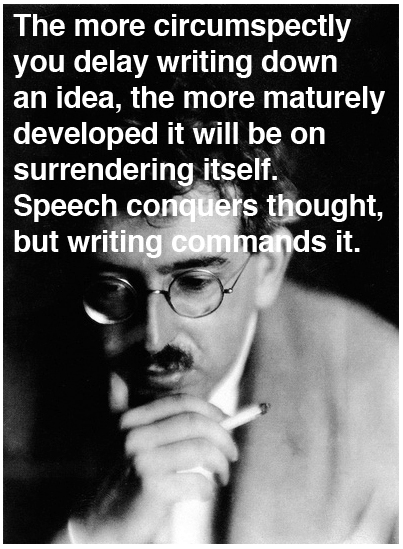
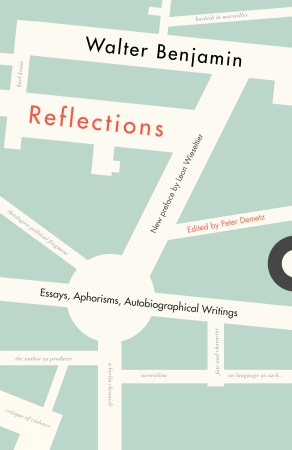
German literary critic, philosopher, and essayists Walter Benjamin. Under a section titled “Post No Bills” in his 1928 treatise One-Way Street, found in his indispensable Reflections: Essays, Aphorisms, Autobiographical Writings (public library), Benjamin offers thirteen essentials of the writer’s technique, touching on familiar themes like the value of keeping a notebook (Virginia Woolf), the incubation period of ideas (T. S. Eliot), the role of discipline (Henry Miller), and the distinct stages of writing (Malcolm Cowley):
“Write with the door closed, rewrite with the door open,” Stephen King advised. “Do back exercises,” Margaret Atwood suggested. “Know everything about adjectives and punctuation, have moral intelligence,” Susan Sontag counseled.
Each accomplished author seems to have a different secret to the craft
of writing, but some of the most enduring advice comes from legendary
German literary critic, philosopher, and essayists Walter Benjamin. Under a section titled “Post No Bills” in his 1928 treatise One-Way Street, found in his indispensable Reflections: Essays, Aphorisms, Autobiographical Writings (public library), Benjamin offers thirteen essentials of the writer’s technique, touching on familiar themes like the value of keeping a notebook (Virginia Woolf), the incubation period of ideas (T. S. Eliot), the role of discipline (Henry Miller), and the distinct stages of writing (Malcolm Cowley):