Tuesday, November 26, 2013


Saturday, November 23, 2013
Tuesday, November 05, 2013
Tuesday, October 15, 2013
Jack Kerouac Lists 9 Essentials for Writing Spontaneous Prose

Jack Kerouac wants you to turn writing into “free deviation (association) of mind into limitless blow-on-subject seas of thought, swimming in sea of English with no discipline, other than rhythms of rhetorical exhalation and expostulated statement….” Think you can do that? Find out by following Kerouac’s “Essentials of Spontaneous Prose.” He published this document in Black Mountain Review in 1957 and wrote it in response to a request from Allen Ginsberg and William S. Burroughs that he explain his method for writing The Subterraneans in three days time.
And for a theory of Kerouac’s not quite theory, visit the site of Marissa M. Juarez, professor of Rhetoric, Composition, and the Teaching of English at the University of Arizona. Juarez raises some salient points about why Kerouac’s “Essentials” bemuse the English teacher: His method “discourages revision… chastises grammatical correctness, and encourages writerly flexibility.” Read Kerouac’s full “Essentials of Spontaneous Prose” here or below. [Note: If you see what looks like typos, they are not errors. They are part of Kerouac's original, spontaneous text.]
SET-UP: The object is set before the mind, either in reality. as in sketching (before a landscape or teacup or old face) or is set in the memory wherein it becomes the sketching from memory of a definite image-object.
PROCEDURE: Time being of the essence in the purity of speech, sketching language is undisturbed flow from the mind of personal secret idea-words, blowing (as per jazz musician) on subject of image.
METHOD: No periods separating sentence-structures already arbitrarily riddled by false colons and timid usually needless commas-but the vigorous space dash separating rhetorical breathing (as jazz musician drawing breath between outblown phrases)– “measured pauses which are the essentials of
our speech”– “divisions of the sounds we hear”- “time and how to note it down.” (William Carlos Williams)
SCOPING: Not “selectivity” of expression but following free deviation (association) of mind into limitless blow-on-subject seas of thought,
swimming in sea of English with no discipline other than rhythms of rhetorical exhalation and expostulated statement, like a fist coming down on a table with each complete utterance, bang! (the space dash)- Blow as deep as you want-write as deeply, fish as far down as you want, satisfy yourself first, then reader cannot fail to receive telepathic shock and meaning-excitement by same laws operating in his own human mind.
LAG IN PROCEDURE: No pause to think of proper word but the infantile pileup of scatological buildup words till satisfaction is gained, which will turn out to be a great appending rhythm to a thought and be in accordance with Great Law of timing.
TIMING: Nothing is muddy that runs in time and to laws of time-Shakespearian stress of dramatic need to speak now in own unalterable way or forever hold tongue-no revisions (except obvious rational mistakes, such as names or calculated insertions in act of not writing but inserting).
CENTER OF INTEREST: Begin not from preconceived idea of what to say about image but from jewel center of interest in subject of image at moment of writing, and write outwards swimming in sea of language to peripheral release and exhaustion-Do not afterthink except for poetic or P. S. reasons. Never afterthink to “improve” or defray impressions, as, the best writing is always the most painful personal wrung-out tossed from cradle warm protective mind-tap from yourself the song of yourself, blow!-now!-your way is your only way- “good”-or “bad”-always honest (“ludi- crous”), spontaneous, “confessionals’ interesting, because not “crafted.” Craft is craft.
STRUCTURE OF WORK: Modern bizarre structures (science fiction, etc.) arise from language being dead, “different” themes give illusion of “new” life. Follow roughly outlines in outfanning movement over subject, as river rock, so mindflow over jewel-center need (run your mind over it, once) arriving at pivot, where what was dim-formed “beginning” becomes sharp-necessitating “ending” and language shortens in race to wire of time-race of work, following laws of Deep Form, to conclusion, last words, last trickle-Night is The End.
MENTAL STATE: If possible write “without consciousness” in semi-trance (as Yeats’ later “trance writing”) allowing subconscious to admit in own uninhibited interesting necessary and so “modern” language what conscious art would censor, and write excitedly, swiftly, with writing-or-typingcramps, in accordance (as from center to periphery) with laws of orgasm, Reich’s “beclouding of consciousness.” Come from within, out-to relaxed and said.
Oh, and for authenticity’s sake, you should try Kerouac’s “Essentials” on a typewriter. It’s all he had when he wrote The Subterraneans. No grammar robots to distract him.
............................
Wednesday, October 09, 2013

Sunday, October 06, 2013
Friday, October 04, 2013
The Anand Gandhi Interview
The Anand Gandhi Interview
Runcil Rebello (RR): Tell me something about Anand Gandhi as a child. What did he read, what films did he watch?
Anand Gandhi (AG): I’ve been exposed to a barrage of images and ideas and thoughts as a child. My grandmom was a spiritual shopper… is a spiritual shopper. She would spend a lot of her days going to satsangs and meeting gurus of all kinds and totally into that. She would say I’m not into religion, I’m into these guys. I’m into sant log. I used to go around with her. My mum was a Bollywood fanatic. She’s a romantic. She loves romantic, sentimental poetry. She used to read Barkat Virani – this very romantic, sentimental poet. Equivalent of Ghalib in Gujarati. And she used to read him as a teenager and think that she would grow up to marry him someday. And I’ll cure him of all his pain and all his hurt. She was like that. She used to expose me to poetry, to cinema, to lots of theater, she used to take me to all these plays, and I would come out of them and say “this is an amazing experience”. I was 5-6 years old and I would be “I can do this, right?” and she would be like “Of course, you can. Why don’t you do it? Why don’t you write a play?” I was six years old when I wrote my first play, and my mom looked at it, and said, “This is genius.” It was highly encouraged. There was always a sense of the tiniest things that I was doing – there was a constant resonance, a constant reflection which was incredibly encouraging and very helpful.
So I saw a lot of cinema, lot of pop cinema, largely Bollywood. Hollywood for us at that time – I’m a child of the eighties – meant Jackie Chan, dubbed Jackie Chan, actually, and Honey, I Shrunk The Kids – like that. So that was the only exposure I had, but the consumption was very high. Also, the fascination ran very deep in everything, and I was encouraged to go all the way. So I wanted to pursue magic very seriously. My mom contacted a magician and asked him to come train me at home and he would train me in small card tricks, and table-top tricks. I spent a lot of time reading magic books and creating my own devices. This was when I was 7-8 years old. I really wanted to grow up to be a scientist. I always imagined that I will become a theoretical physicist someday. At that time, it was a scientist of course, I didn’t know what a physicist meant. Oh wow, Newton and Galileo, they were just like me when they were children. So I used to be fascinated by these ideas, and I was always encouraged.
I think there were a lot of disadvantages that became advantages at some point in time. For instance, a complete disinterest and a lack of aptitude in sport. Lack of a muscular body, I was really fat, absolutely no enthusiasm allowed me to do a lot of things that was entirely exciting and fascinating and on the other hand was compensatory. Compensating for the inability to be able to relate to children in the chawl I was growing up in. That was what childhood was like. Resources was limited, lived in a single room made of crude sheets of tins, brick walls, no tiling. That was natural, a way of life. It wasn’t perceived or communicated as an absence of resources. Everything that had to do with intellectual pursuit was highly encouraged. Science was encouraged, magic was encouraged, writing was encouraged, painting was encouraged – all sorts of intellectual pursuits were highly encouraged. Sacrifices were made by my mum and grandmum so I could pursue my notions of being an inventor – which I thought I was when I was nine years old. They would leave their jobs at hand or take to long-distance tours just to bring me things that I had read on books, material that you just cannot find anywhere. We’re talking of stuff like ‘spring with the caliber of so-and-so’, ‘0.3 mm of so-and-so’. Where the fuck am I going to get something like that? If you want to make a motor or a seismograph, and you try to make them because everything has been replaced by something else, and they would fall apart. But everything was encouraged. Choices were encouraged. Like when I was 8 or 9, I just told my mother that it doesn’t make sense that people burst firecrackers during Diwali. It’s not attractive, it’s incredibly irritating, it produces this noise – I was damn irritated by it as a child. I could not see how anyone was attracted to lighting a sutli bomb. I was like it produces a huge band, so what? It didn’t make any sense to me. So when I was 9 years old I went to my mom and told her this Diwali onwards I’m not going to burn any crackers. So do you you have a budget kept aside for anything like that? So she was like yea, I have forty bucks. So I was like Children’s Knowledge Bank Part 3 costs 18 rupees, so maybe I can buy both part 2 and part 3, which were the books I’d read for my Homi Bhabha Science competition which happens in classrooms.
RR: Your parents must have been very happy with you.
AG: I was very academically inclined, I was very attracted to knowledge. Deeply attracted to knowing and finding, I was extremely curious. And that was encouraged.
 RR: So you’ve always had this ‘explorer’ streak within you. When did storytelling enter the scene?
AG: It was a part of it. Only later in life was I able to see the continuum between all of them. Because especially when you’re growing up in India, you are always told “you can only do this.” The rest all is hobby. When you’re raised in that kind of an environment, where there is no infrastructure to groom a certain kind of thinking, a certain kind of envisioning, you kind of fall back on what is available. I was attracted to everything at the same time. I could not choose one over the other. I did not see why I had to choose one over the other. And that’s the reason I dropped out of college also. I just couldn’t consign to the idea that you could choose only one; it just did not make any sense to me. I was like, I’m incredibly interested in scientific inquiry, I’m interested in the inferences of physics, of microbiology, and neurosciences. But what do I do with that information if I don’t have the philosophy. If I don’t interpret the information being produced by scientific inquiry, that information is meaningless. What is this God Particle? What is this Higgs Boson? If I’m not able to interpret the information produced by the scientific inquiry, then it’s of no use to me. I need to know how it changes my life, I need to know how to use it to become a better person. How can I use it to make life around me better, more beautiful and engaging? So ‘satyam’ by itself is of no use, ‘shivam’ and ‘sunderam’ is also necessary. I need to use the satyam – the fact – produced by scientific inquiry and juxtapose it with the environment, with myself, with everything around and put a meaningful structure to it. Then I’ll find my role really relevant if I can take that inference, take that assimilation and weave it into narrative metaphor so that it can reach a really wide audience because that’s how inquiry has reached me. I was enlightened by cinema, you know, I was informed by cinema and theater, I came to know of a lot of things in life because of popular cinema and theater. So I thought it’s such a powerful medium and as I grew older I realised it is being utterly under-utilised. It’s a medium that can, while actually engaging you in a story, while engaging you in narrative, while entertaining you, it can/has the potential of actually enlightening you. It has the potential of bringing a rich and profound experience in you, profound epiphanies in you. Also, I became increasingly attracted to playing that role in life – That I can be magician, a scientist, a philosopher, an actor, a writer, – all of that together if I become a filmmaker.
RR: You’ve talked about entertainment and enlightenment. Which films in the recent past have you felt manage to do both?
AG: A lot of film. The Turin Horse was that for me. But it won’t be considered entertaining by a lot of people. For me it was engaging, entertaining and enlightening. Michael Haneke’s The White Ribbon was truly engaging and enlightening. Holy Motors was one film – there was a different kind of enlightenment – it opened up areas of examining – triggers – for me. Like how triggers can be triggers for triggers for triggers for experience. The whole sophistication of its simulation system was so high-end, so amazing. That enlightened me while entertaining me recently. And there are lots of other films. One film that was for me hugely entertaining, that was a big boost in my wanting to make films after that was The Matrix. I was 17 years old when I saw the film. I was just blown away by it. All the ideas that I’ve ever thought about, all the ideas that I’ve ever been attracted to, the idea of simulation, the idea of illusion, the idea of examining reality, social constructs, religious constructs, evolution of religion. All these ideas are in there with so much entertainment, so much accessibility. When I was 17, it just meant so much to me that time.
RR: Coming to Ship Of Theseus, why the eyes, the liver and the kidney? Why these three organs, or were there more while scripting?
AG: There were other organs as well. The initial idea was to make a story about 8 people. Then when I wrote the script, I wrote it about four people. There was also a heart. And by the time I started shooting, I started realising “This is going to be a very long film with three stories itself.” The fourth one in there is not going to be a film. It’s going to be a prolonged experience of some kind. It would have been a four hour long film. It would have been an impossibility. It was only due to the limitations of the medium. At the end, you can watch a film at a stretch for two and a half hours max.
 RR:
There are people who have watched the film and said “It isn’t complex.”
But there are many others who think the film is complex and some think
it is a talkie. How do you intend to dispel these qualms, or are you
even trying to dispel them?
AG: We are all equipped with different kinds of language. We are all equipped with different idioms. And we have all been informed and groomed by a series of experiences and education. Now within that paradigm, each one of us is going to have a certain kind of a _______ (audio unclear) My attempt would be to make the film as vast as possible. There is something in it for everybody. I’m Gujarati. I was raised in a culture where you have the thali. I was raised on popular culture where there is a thali on film also. Hindi popular film is where you have comedy, and dance and tragedy and romance. At an essential level, that is what I’ve done with Ship Of Theseus. It’s a film where you have so many ideas. It also has three filmmaking styles in it. Each story has been made in a different style. The approach has been completely different. So the first film is not that dependent on conversation, the third film is not that dependent on conversation. The second film is driven by the discourse. The first film is driven only by the image. The third film is driven only by the relationships: the interactions and the emotions. So each filmmaking style is different, each cinematographic style is very different. The film is really vast and the attempt is to have the range of experiences that we have had which is usually chaos. Because the magnitude of human experiences is so vast, and to fit it down into a reduced, bumper sticker is incredibly difficult. But that has been the inspiration, to pin it down, to nail down with rigour that it’s meaningful as a whole. And also the aspiration is that the whole is greater than the sum of the parts. The parts are extremely transparent and visible. If you see the parts unfolding one after the other, you can see the parts, enjoy the parts, and suddenly when it comes to the end, you have an experience where you’re like how did this happen? How did the whole – this experience that I have had is suddenly so much greater than the sum of the parts that I just saw. That is the aspiration, that is the attempt. I feel that some people have felt that way, at least.
RR: How was it after the World Premiere at Toronto where it got unanimous acclaim? What were your expectations, and did you get that?
AG: See the problem with an optimist is that you’re not pleasantly surprised. I’m an optimist. One of my closest friends is a cynic. He’s a pessimist. He says, “Toronto mein itne logon ne bol diya life-changing film hai, usse pav-wada wala thodi tujhko extra chutney dega.” So he’s always happily surprised. I’m never happily surprised because I expect the best and when it happens, I’m like, “alright, it was expected.” What I’d expected at Toronto was that the cinephile community, that the film will give a very deep and profound experience to some people. That I’d expected. What I’d not expected was that it will give a profound experience to everyone. That was unexpected. We were walking the streets of Toronto and people were coming and hugging us, “My life has changed, I’ve never experienced anything like this before.” That was still happily surprising.
RR: What was the situation of the release of the film before Kiran Rao entered the scene?
AG: We hadn’t talked to anyone yet. We were going to talk to some people. We were talking internally about reaching out to some people, but there were no serious talks, no serious engagements with anyone. We were still doing festival rounds. “Baad mein dekha jaayega.” And Sohum Shah is also like a mad visionary. Because he was acting in the film and he believed in the film so much, he’s like “You’re saying that the film is unprecedented. How can you expect anyone to understand something that is unprecedented?” Because I was looking for financing at that time, and he was rehearsing with me everyday. I would go to multiple producers and their reaction would be “This is amazing. Kya script likha hai! Kya kahaani hai! Wow. Par yeh India mein nahi samajh mein aayega logon ko.” The presumptuous arrogance is that ‘Main bahut intelligent hoon, mujhe bahut samajh mein aaya, main keh sakta hoon bahut kamaal hai. But Indian audience nahi samajh paayegi. Indian audience bechaare log hai.” That’s a presumption about 1/5th of human population. So Sohum would tell me, if we know there’s no precedence to anything like this, what reference do we have? He empathised with those people. “They’re businessmen. Unko kya pata hai yeh product ko kaise sell karein. Mujhe pata hai. So we should support it. I’ll put in all my money. Don’t worry about it. Go and make this film.”
He’s a bit of an anarchist, a visionary. Like fuck everything, we’ll do it our way. It’s also because of someone like him, the film could happen.
 RR: How do you think Kiran Rao is going to help you get more of an audience?
AG: See, Kiran is an amazing woman. She’s so driven and passionate about the cinema she loves. And it’s been a while since she said that a film has meant so much to her. She loved the film. She said that “I have not had this kind of a cinematic experience in the longest time.” You tell me, what’s next. We started talking about life, universe, cinema. We became really good friends, and in that period I kinda suggested about the possibility of her presenting the film. For the last few years, she has already engaged with a lot of audience. She’s made Dhobi Ghat, she’s produced Peepli [Live]. She knows the infrastructure very well. She knows this particular audience very well, who is a certain audience for this film. She also knows how to use the infrastructure to expand into the audience, who yet don’t know that they want to see this film. I feel there is a huge audience out there who haven’t sampled this kind of cinema and who hence don’t know yet that they want to see this. Once they see it, they would completely get hooked on to it. They would be like, “Oh fuck, yeh kyun koi nahi banata?” You look at youtube, twitter reactions, and people are saying life-changing experience, etc., there is also an audience how is saying “humne aisa kuch dekha hi nahi hai. Why don’t people make this in Bollywood?” So there is an audience that has not yet had a privilege that I had when I was 17 years old, who will come to this film and say this is the kind of cinema we want to see. And Kiran becomes a great medium for that kind of a communication. She’s already established an infrastructure, she already has access to a huge audience with whom she has been engaging with. She has also gained a huge amount of trust with distributors and exhibitors. She has brought in a huge amount of force that is becoming the vehicle of the film.
RR: Since you are now familiar with them, if you have a script for Aamir Khan, would you approach him?
AG: Yes. In fact, Aamir has shown a lot of enthusiasm, he loved Ship Of Theseus, he said that if you have anything that I could do, he would love to do it. He said whatever you are writing next, he would love to look at it, love to read it and see if that excites me. I wouldn’t mind that either. But the thing is, I can imagine Aamir giving that type of a commitment. You have seen the actors that are committed to the films I have made so far. The commitment is of a very severe level. The opportunity, costs become greater. Sohum Shah just spends an entire year doing that film. He eats, breathes, lives that film. When he was doing Ship Of Theseus, he put on weight, he became paunchy, he looks very different. He transformed, he changed his body language. He added small things. Neeraj Kabi, he lost 17 kgs. The commitment was 4 months before the shoot, he started getting rigourously involved with the philosophy of the film. So he became the philosopher he’s supposed to play first so that when he says those lines, it comes out with a sense of commitment. He went from being a non-vegetarian to a vegetarian. He committed to the rigourous diet that the film required him to go through. So the films that I’m making require a huge amount of commitment. I’m certain that if Aamir is convinced about the film, he would be willing to give in to that kind of a rigour. So that’s a relationship I’m completely open to.
RR: You’re pretty lucky getting a release on such a huge scale. How would you feel if you were in the place of an indie filmmaker who has made a good film which is not getting an opportunity for a release? Would you be jealous of yourself?
AG: My peers have been very kind to not be jealous or communicate any jealousy to me. They’ve all been very excited about the release. I understand your question. I’ve been fortunate to have found the crew, actors, producer I found. Found Kiran eventually. Just been a series of good fortune for me. For somebody who has not had that, for somebody who has made a film that is good, that is not necessarily pathbreaking, because you can’t always expect cinema of that kind. A film that is good, that can mean something to some people, that can have resonance and still not finding release – it’s a really bad situation then. It’s a situation that needs amendment, it’s a situation that needs very active audience participation. For instance, if there’s corruption, they need to come on the street and fight corruption. If we are not getting our basic amenities, we need to come on the streets and fight for it. Similarly, when out culture is so impoverished, is so poor and so low-brow, we definitely need to come to the streets and fight for a better culture, better ideas, because our life depends on culture. Our collective well-being, our social well-being, our economy depends on our intellect as a people. And films are the biggest medium for that kind of enlightenment. So I think people should participate in it very actively. The state should take a very active responsibility. It’s annoying that the state is not considering cinema as an important cultural vehicle for bringing about a social change, an intellectual evolution, a collective dialogue and introspection among people. Cinema around the world is such a powerful medium for that kind of an engagement. It is really a shame that the state is not looking at it that way. A certain kind of cinema should be tax-free. Tax should be totally lifted from cinema as a product of culture because it is something that will enrich us as a society.
RR: How has the entire experience of making the film and releasing it now changed you as a person?
AG: It’s very transformative. Growing up, you read about Satyajit Ray and Ritwik Ghatak and from other filmmakers from around the world like Ingmar Bergman, how one film completely transforms you as a person. And you think it’s a romantic expression, you know. It’s only after you have gone through this process, I have realised how physical it is, how real it is. It’s incredibly real – the transformative experience. I’ve gone through an exponential change I’ve become much larger than what I started out as. And I feel more calm, more secure. I feel more enlightened. I feel better about myself as a person. I feel I’m more equipped to do things. I also have grey hair. I only had black hair when I started out. One film made my hair go grey.
 RR: If you had to discuss your script with your peers, who would you go to?
AG: Khushboo Ranka, who worked on the story of Ship Of Theseus, she’s just one powerhouse of talent, and her vision and her talent is incomparable. She is right now in Delhi directing a documentary that I’m producing. Kiran is someone I’ve begun to trust, begun to rely on, begun to love talking to. The reflections she comes up with, the nuances she comes up with… she’s so compassionate, she’s so effervescent, and enthused, loving and generous. And she always brings in perspectives that are extremely human and empathetic to every idea I discuss with her. Megha Ramaswamy – she’s one of the brightest minds we have right now. She’s just extremely deep in her understanding of beauty and aesthetics, in her vision as a filmmaker and a writer. Chaitanya Tamhane is making his new film, Court, which is currently in post-production. Pankaj Kumar, my DoP, as far as I am concerned, I can say this, he is really the greatest artist working in India right now. He shot Ship Of Theseus, he shot Thumbad, he’s already been awarded four international awards. Everywhere in the world, they are saying this cinematographer, his vision is the newest vision. Transylvania people were ballistic “What the fuck was that?” “How can one see something like that?” I go to him right when I have an idea.
RR: What are your forthcoming ventures?
AG: Thumbad is in post-production. I have produced it, Sohum Shah has acted in it. Rahi Barve directed it. Rahi had shot his short film called Manja, that was really celebrated, everyone had loved it. It did rounds of festivals, won awards. Danny Boyle called it one of the most important films to come out of India. He distributed it on the Slumdog Millionaire blu-ray. This was also shot by Pankaj Kumar. Lot of people around Boyle at that time said that it’s better shot than Slumdog. And it is. Anthony Dod Mantle is a great cinematographer. But Pankaj Kumar is Pankaj Kumar. He’s a genius.
 RR: Anything that you are writing for yourself to direct?
AG: I’m writing a lot of things. There’s one film from that that we’re doing very soon. Again, with Sohum in it. But I’ll have to work more on it to make it presentable.
RR: Is there any genre that you as a director wouldn’t tackle?
AG: I’m not really attracted to gangster films. I just don’t get it. What’s so exciting about people killing each other? Like really stupid, frivolous people killing each other. I just don’t get it.
RR: So you didn’t like Gangs Of Wasseypur?
AG: I don’t get it. Like karne mein kya hai, I can even like jokes cracked by my friends. I don’t understand what’s so cool about making a film about gangsters. Unless there is an inquiry into it. Unless you’re informing me about the nature of revenge, the primitive need to avenge another, the social need for such a thing to occur and sustain. If you’re informing me in a very intellectual manner and a true discourse. If you’re showing me what’s happening, also show me why it’s happening, and not superficial reasons – not “politics make gangsters”. You know, like, deeply profound reasons of why something like that exists in the first place, which engages in at rue discourse, which enlightens me about – oh, this is the nature of violence, this is the nature of revenge, this is the nature of trying to capture resources through violence. If it’s informing me in a very deep way about something, then yes. But I don’t know anything like that.
RR: What kind of a director are you? Do you tell your actors I want stuff like this and this, or do you give them the script and let them do what they want?
AG: It’s actually both. See, before and after reading the script, they spend a long period of time with me. So I need to have a deep and personal connection with each and every actor I’m working with, so that I can communicate with them. The communication channel in my case becomes so transparent and it’s so strong that my actors and I fully and completely understand each other. Before even handing them the script, I’ve engaged them in a series of debates, a series of questions, a series of experiences that that character would have had. Then I give them the script. So at the script level, they’ve already gone through a long process, and even after that they go through a long process. So it’s a very rigorous and tedious approach.
RR: About your Kyunki Saas Bhi Kabhi Bahu Thi days, did you ever at that time, that you would be stuck here, and no one would ever be able to hear your voice, read your stuff?
AG: I was very young at that time to have any serious insecurity. I had very small insecurities. Will I be able to do things I wanna do? Will I be able to learn, educate, travel? Will I be able to make a film? So while writing Kyunki Saas Bhi Kabhi Bahu Thi and Kahaani Ghar Ghar Ki was a great experience it was actually putting me in a space where I was writing constantly something that was meant for mass consumption, while I was also writing plays that was meant for consumption of a small group of people. So it was a great place to be in to be able to experience both the distinct types.
RR: So you were certain that somewhere down the line, you would be able to get people to listen to you.
AG: I was very certain about it. I don’t know, I feel you need a certain amount of naivety to be so certain. You need to be a little innocent to be so certain. It’s like “arre yaar, apne se nahi hoga toh kisse hoga?” certainty and that’s a good driving force.
Runcil Rebello (RR): Tell me something about Anand Gandhi as a child. What did he read, what films did he watch?
Anand Gandhi (AG): I’ve been exposed to a barrage of images and ideas and thoughts as a child. My grandmom was a spiritual shopper… is a spiritual shopper. She would spend a lot of her days going to satsangs and meeting gurus of all kinds and totally into that. She would say I’m not into religion, I’m into these guys. I’m into sant log. I used to go around with her. My mum was a Bollywood fanatic. She’s a romantic. She loves romantic, sentimental poetry. She used to read Barkat Virani – this very romantic, sentimental poet. Equivalent of Ghalib in Gujarati. And she used to read him as a teenager and think that she would grow up to marry him someday. And I’ll cure him of all his pain and all his hurt. She was like that. She used to expose me to poetry, to cinema, to lots of theater, she used to take me to all these plays, and I would come out of them and say “this is an amazing experience”. I was 5-6 years old and I would be “I can do this, right?” and she would be like “Of course, you can. Why don’t you do it? Why don’t you write a play?” I was six years old when I wrote my first play, and my mom looked at it, and said, “This is genius.” It was highly encouraged. There was always a sense of the tiniest things that I was doing – there was a constant resonance, a constant reflection which was incredibly encouraging and very helpful.
So I saw a lot of cinema, lot of pop cinema, largely Bollywood. Hollywood for us at that time – I’m a child of the eighties – meant Jackie Chan, dubbed Jackie Chan, actually, and Honey, I Shrunk The Kids – like that. So that was the only exposure I had, but the consumption was very high. Also, the fascination ran very deep in everything, and I was encouraged to go all the way. So I wanted to pursue magic very seriously. My mom contacted a magician and asked him to come train me at home and he would train me in small card tricks, and table-top tricks. I spent a lot of time reading magic books and creating my own devices. This was when I was 7-8 years old. I really wanted to grow up to be a scientist. I always imagined that I will become a theoretical physicist someday. At that time, it was a scientist of course, I didn’t know what a physicist meant. Oh wow, Newton and Galileo, they were just like me when they were children. So I used to be fascinated by these ideas, and I was always encouraged.
I think there were a lot of disadvantages that became advantages at some point in time. For instance, a complete disinterest and a lack of aptitude in sport. Lack of a muscular body, I was really fat, absolutely no enthusiasm allowed me to do a lot of things that was entirely exciting and fascinating and on the other hand was compensatory. Compensating for the inability to be able to relate to children in the chawl I was growing up in. That was what childhood was like. Resources was limited, lived in a single room made of crude sheets of tins, brick walls, no tiling. That was natural, a way of life. It wasn’t perceived or communicated as an absence of resources. Everything that had to do with intellectual pursuit was highly encouraged. Science was encouraged, magic was encouraged, writing was encouraged, painting was encouraged – all sorts of intellectual pursuits were highly encouraged. Sacrifices were made by my mum and grandmum so I could pursue my notions of being an inventor – which I thought I was when I was nine years old. They would leave their jobs at hand or take to long-distance tours just to bring me things that I had read on books, material that you just cannot find anywhere. We’re talking of stuff like ‘spring with the caliber of so-and-so’, ‘0.3 mm of so-and-so’. Where the fuck am I going to get something like that? If you want to make a motor or a seismograph, and you try to make them because everything has been replaced by something else, and they would fall apart. But everything was encouraged. Choices were encouraged. Like when I was 8 or 9, I just told my mother that it doesn’t make sense that people burst firecrackers during Diwali. It’s not attractive, it’s incredibly irritating, it produces this noise – I was damn irritated by it as a child. I could not see how anyone was attracted to lighting a sutli bomb. I was like it produces a huge band, so what? It didn’t make any sense to me. So when I was 9 years old I went to my mom and told her this Diwali onwards I’m not going to burn any crackers. So do you you have a budget kept aside for anything like that? So she was like yea, I have forty bucks. So I was like Children’s Knowledge Bank Part 3 costs 18 rupees, so maybe I can buy both part 2 and part 3, which were the books I’d read for my Homi Bhabha Science competition which happens in classrooms.
RR: Your parents must have been very happy with you.
AG: I was very academically inclined, I was very attracted to knowledge. Deeply attracted to knowing and finding, I was extremely curious. And that was encouraged.

Anand Gandhi
AG: It was a part of it. Only later in life was I able to see the continuum between all of them. Because especially when you’re growing up in India, you are always told “you can only do this.” The rest all is hobby. When you’re raised in that kind of an environment, where there is no infrastructure to groom a certain kind of thinking, a certain kind of envisioning, you kind of fall back on what is available. I was attracted to everything at the same time. I could not choose one over the other. I did not see why I had to choose one over the other. And that’s the reason I dropped out of college also. I just couldn’t consign to the idea that you could choose only one; it just did not make any sense to me. I was like, I’m incredibly interested in scientific inquiry, I’m interested in the inferences of physics, of microbiology, and neurosciences. But what do I do with that information if I don’t have the philosophy. If I don’t interpret the information being produced by scientific inquiry, that information is meaningless. What is this God Particle? What is this Higgs Boson? If I’m not able to interpret the information produced by the scientific inquiry, then it’s of no use to me. I need to know how it changes my life, I need to know how to use it to become a better person. How can I use it to make life around me better, more beautiful and engaging? So ‘satyam’ by itself is of no use, ‘shivam’ and ‘sunderam’ is also necessary. I need to use the satyam – the fact – produced by scientific inquiry and juxtapose it with the environment, with myself, with everything around and put a meaningful structure to it. Then I’ll find my role really relevant if I can take that inference, take that assimilation and weave it into narrative metaphor so that it can reach a really wide audience because that’s how inquiry has reached me. I was enlightened by cinema, you know, I was informed by cinema and theater, I came to know of a lot of things in life because of popular cinema and theater. So I thought it’s such a powerful medium and as I grew older I realised it is being utterly under-utilised. It’s a medium that can, while actually engaging you in a story, while engaging you in narrative, while entertaining you, it can/has the potential of actually enlightening you. It has the potential of bringing a rich and profound experience in you, profound epiphanies in you. Also, I became increasingly attracted to playing that role in life – That I can be magician, a scientist, a philosopher, an actor, a writer, – all of that together if I become a filmmaker.
RR: You’ve talked about entertainment and enlightenment. Which films in the recent past have you felt manage to do both?
AG: A lot of film. The Turin Horse was that for me. But it won’t be considered entertaining by a lot of people. For me it was engaging, entertaining and enlightening. Michael Haneke’s The White Ribbon was truly engaging and enlightening. Holy Motors was one film – there was a different kind of enlightenment – it opened up areas of examining – triggers – for me. Like how triggers can be triggers for triggers for triggers for experience. The whole sophistication of its simulation system was so high-end, so amazing. That enlightened me while entertaining me recently. And there are lots of other films. One film that was for me hugely entertaining, that was a big boost in my wanting to make films after that was The Matrix. I was 17 years old when I saw the film. I was just blown away by it. All the ideas that I’ve ever thought about, all the ideas that I’ve ever been attracted to, the idea of simulation, the idea of illusion, the idea of examining reality, social constructs, religious constructs, evolution of religion. All these ideas are in there with so much entertainment, so much accessibility. When I was 17, it just meant so much to me that time.
RR: Coming to Ship Of Theseus, why the eyes, the liver and the kidney? Why these three organs, or were there more while scripting?
AG: There were other organs as well. The initial idea was to make a story about 8 people. Then when I wrote the script, I wrote it about four people. There was also a heart. And by the time I started shooting, I started realising “This is going to be a very long film with three stories itself.” The fourth one in there is not going to be a film. It’s going to be a prolonged experience of some kind. It would have been a four hour long film. It would have been an impossibility. It was only due to the limitations of the medium. At the end, you can watch a film at a stretch for two and a half hours max.
A still from Ship Of Theseus
AG: We are all equipped with different kinds of language. We are all equipped with different idioms. And we have all been informed and groomed by a series of experiences and education. Now within that paradigm, each one of us is going to have a certain kind of a _______ (audio unclear) My attempt would be to make the film as vast as possible. There is something in it for everybody. I’m Gujarati. I was raised in a culture where you have the thali. I was raised on popular culture where there is a thali on film also. Hindi popular film is where you have comedy, and dance and tragedy and romance. At an essential level, that is what I’ve done with Ship Of Theseus. It’s a film where you have so many ideas. It also has three filmmaking styles in it. Each story has been made in a different style. The approach has been completely different. So the first film is not that dependent on conversation, the third film is not that dependent on conversation. The second film is driven by the discourse. The first film is driven only by the image. The third film is driven only by the relationships: the interactions and the emotions. So each filmmaking style is different, each cinematographic style is very different. The film is really vast and the attempt is to have the range of experiences that we have had which is usually chaos. Because the magnitude of human experiences is so vast, and to fit it down into a reduced, bumper sticker is incredibly difficult. But that has been the inspiration, to pin it down, to nail down with rigour that it’s meaningful as a whole. And also the aspiration is that the whole is greater than the sum of the parts. The parts are extremely transparent and visible. If you see the parts unfolding one after the other, you can see the parts, enjoy the parts, and suddenly when it comes to the end, you have an experience where you’re like how did this happen? How did the whole – this experience that I have had is suddenly so much greater than the sum of the parts that I just saw. That is the aspiration, that is the attempt. I feel that some people have felt that way, at least.
RR: How was it after the World Premiere at Toronto where it got unanimous acclaim? What were your expectations, and did you get that?
AG: See the problem with an optimist is that you’re not pleasantly surprised. I’m an optimist. One of my closest friends is a cynic. He’s a pessimist. He says, “Toronto mein itne logon ne bol diya life-changing film hai, usse pav-wada wala thodi tujhko extra chutney dega.” So he’s always happily surprised. I’m never happily surprised because I expect the best and when it happens, I’m like, “alright, it was expected.” What I’d expected at Toronto was that the cinephile community, that the film will give a very deep and profound experience to some people. That I’d expected. What I’d not expected was that it will give a profound experience to everyone. That was unexpected. We were walking the streets of Toronto and people were coming and hugging us, “My life has changed, I’ve never experienced anything like this before.” That was still happily surprising.
RR: What was the situation of the release of the film before Kiran Rao entered the scene?
AG: We hadn’t talked to anyone yet. We were going to talk to some people. We were talking internally about reaching out to some people, but there were no serious talks, no serious engagements with anyone. We were still doing festival rounds. “Baad mein dekha jaayega.” And Sohum Shah is also like a mad visionary. Because he was acting in the film and he believed in the film so much, he’s like “You’re saying that the film is unprecedented. How can you expect anyone to understand something that is unprecedented?” Because I was looking for financing at that time, and he was rehearsing with me everyday. I would go to multiple producers and their reaction would be “This is amazing. Kya script likha hai! Kya kahaani hai! Wow. Par yeh India mein nahi samajh mein aayega logon ko.” The presumptuous arrogance is that ‘Main bahut intelligent hoon, mujhe bahut samajh mein aaya, main keh sakta hoon bahut kamaal hai. But Indian audience nahi samajh paayegi. Indian audience bechaare log hai.” That’s a presumption about 1/5th of human population. So Sohum would tell me, if we know there’s no precedence to anything like this, what reference do we have? He empathised with those people. “They’re businessmen. Unko kya pata hai yeh product ko kaise sell karein. Mujhe pata hai. So we should support it. I’ll put in all my money. Don’t worry about it. Go and make this film.”
He’s a bit of an anarchist, a visionary. Like fuck everything, we’ll do it our way. It’s also because of someone like him, the film could happen.
Sohum Shah, Kiran Rao and Anand Gandhi
AG: See, Kiran is an amazing woman. She’s so driven and passionate about the cinema she loves. And it’s been a while since she said that a film has meant so much to her. She loved the film. She said that “I have not had this kind of a cinematic experience in the longest time.” You tell me, what’s next. We started talking about life, universe, cinema. We became really good friends, and in that period I kinda suggested about the possibility of her presenting the film. For the last few years, she has already engaged with a lot of audience. She’s made Dhobi Ghat, she’s produced Peepli [Live]. She knows the infrastructure very well. She knows this particular audience very well, who is a certain audience for this film. She also knows how to use the infrastructure to expand into the audience, who yet don’t know that they want to see this film. I feel there is a huge audience out there who haven’t sampled this kind of cinema and who hence don’t know yet that they want to see this. Once they see it, they would completely get hooked on to it. They would be like, “Oh fuck, yeh kyun koi nahi banata?” You look at youtube, twitter reactions, and people are saying life-changing experience, etc., there is also an audience how is saying “humne aisa kuch dekha hi nahi hai. Why don’t people make this in Bollywood?” So there is an audience that has not yet had a privilege that I had when I was 17 years old, who will come to this film and say this is the kind of cinema we want to see. And Kiran becomes a great medium for that kind of a communication. She’s already established an infrastructure, she already has access to a huge audience with whom she has been engaging with. She has also gained a huge amount of trust with distributors and exhibitors. She has brought in a huge amount of force that is becoming the vehicle of the film.
RR: Since you are now familiar with them, if you have a script for Aamir Khan, would you approach him?
AG: Yes. In fact, Aamir has shown a lot of enthusiasm, he loved Ship Of Theseus, he said that if you have anything that I could do, he would love to do it. He said whatever you are writing next, he would love to look at it, love to read it and see if that excites me. I wouldn’t mind that either. But the thing is, I can imagine Aamir giving that type of a commitment. You have seen the actors that are committed to the films I have made so far. The commitment is of a very severe level. The opportunity, costs become greater. Sohum Shah just spends an entire year doing that film. He eats, breathes, lives that film. When he was doing Ship Of Theseus, he put on weight, he became paunchy, he looks very different. He transformed, he changed his body language. He added small things. Neeraj Kabi, he lost 17 kgs. The commitment was 4 months before the shoot, he started getting rigourously involved with the philosophy of the film. So he became the philosopher he’s supposed to play first so that when he says those lines, it comes out with a sense of commitment. He went from being a non-vegetarian to a vegetarian. He committed to the rigourous diet that the film required him to go through. So the films that I’m making require a huge amount of commitment. I’m certain that if Aamir is convinced about the film, he would be willing to give in to that kind of a rigour. So that’s a relationship I’m completely open to.
RR: You’re pretty lucky getting a release on such a huge scale. How would you feel if you were in the place of an indie filmmaker who has made a good film which is not getting an opportunity for a release? Would you be jealous of yourself?
AG: My peers have been very kind to not be jealous or communicate any jealousy to me. They’ve all been very excited about the release. I understand your question. I’ve been fortunate to have found the crew, actors, producer I found. Found Kiran eventually. Just been a series of good fortune for me. For somebody who has not had that, for somebody who has made a film that is good, that is not necessarily pathbreaking, because you can’t always expect cinema of that kind. A film that is good, that can mean something to some people, that can have resonance and still not finding release – it’s a really bad situation then. It’s a situation that needs amendment, it’s a situation that needs very active audience participation. For instance, if there’s corruption, they need to come on the street and fight corruption. If we are not getting our basic amenities, we need to come on the streets and fight for it. Similarly, when out culture is so impoverished, is so poor and so low-brow, we definitely need to come to the streets and fight for a better culture, better ideas, because our life depends on culture. Our collective well-being, our social well-being, our economy depends on our intellect as a people. And films are the biggest medium for that kind of enlightenment. So I think people should participate in it very actively. The state should take a very active responsibility. It’s annoying that the state is not considering cinema as an important cultural vehicle for bringing about a social change, an intellectual evolution, a collective dialogue and introspection among people. Cinema around the world is such a powerful medium for that kind of an engagement. It is really a shame that the state is not looking at it that way. A certain kind of cinema should be tax-free. Tax should be totally lifted from cinema as a product of culture because it is something that will enrich us as a society.
RR: How has the entire experience of making the film and releasing it now changed you as a person?
AG: It’s very transformative. Growing up, you read about Satyajit Ray and Ritwik Ghatak and from other filmmakers from around the world like Ingmar Bergman, how one film completely transforms you as a person. And you think it’s a romantic expression, you know. It’s only after you have gone through this process, I have realised how physical it is, how real it is. It’s incredibly real – the transformative experience. I’ve gone through an exponential change I’ve become much larger than what I started out as. And I feel more calm, more secure. I feel more enlightened. I feel better about myself as a person. I feel I’m more equipped to do things. I also have grey hair. I only had black hair when I started out. One film made my hair go grey.
A still from Ship Of Theseus
AG: Khushboo Ranka, who worked on the story of Ship Of Theseus, she’s just one powerhouse of talent, and her vision and her talent is incomparable. She is right now in Delhi directing a documentary that I’m producing. Kiran is someone I’ve begun to trust, begun to rely on, begun to love talking to. The reflections she comes up with, the nuances she comes up with… she’s so compassionate, she’s so effervescent, and enthused, loving and generous. And she always brings in perspectives that are extremely human and empathetic to every idea I discuss with her. Megha Ramaswamy – she’s one of the brightest minds we have right now. She’s just extremely deep in her understanding of beauty and aesthetics, in her vision as a filmmaker and a writer. Chaitanya Tamhane is making his new film, Court, which is currently in post-production. Pankaj Kumar, my DoP, as far as I am concerned, I can say this, he is really the greatest artist working in India right now. He shot Ship Of Theseus, he shot Thumbad, he’s already been awarded four international awards. Everywhere in the world, they are saying this cinematographer, his vision is the newest vision. Transylvania people were ballistic “What the fuck was that?” “How can one see something like that?” I go to him right when I have an idea.
RR: What are your forthcoming ventures?
AG: Thumbad is in post-production. I have produced it, Sohum Shah has acted in it. Rahi Barve directed it. Rahi had shot his short film called Manja, that was really celebrated, everyone had loved it. It did rounds of festivals, won awards. Danny Boyle called it one of the most important films to come out of India. He distributed it on the Slumdog Millionaire blu-ray. This was also shot by Pankaj Kumar. Lot of people around Boyle at that time said that it’s better shot than Slumdog. And it is. Anthony Dod Mantle is a great cinematographer. But Pankaj Kumar is Pankaj Kumar. He’s a genius.
A still from Ship Of Theseus
AG: I’m writing a lot of things. There’s one film from that that we’re doing very soon. Again, with Sohum in it. But I’ll have to work more on it to make it presentable.
RR: Is there any genre that you as a director wouldn’t tackle?
AG: I’m not really attracted to gangster films. I just don’t get it. What’s so exciting about people killing each other? Like really stupid, frivolous people killing each other. I just don’t get it.
RR: So you didn’t like Gangs Of Wasseypur?
AG: I don’t get it. Like karne mein kya hai, I can even like jokes cracked by my friends. I don’t understand what’s so cool about making a film about gangsters. Unless there is an inquiry into it. Unless you’re informing me about the nature of revenge, the primitive need to avenge another, the social need for such a thing to occur and sustain. If you’re informing me in a very intellectual manner and a true discourse. If you’re showing me what’s happening, also show me why it’s happening, and not superficial reasons – not “politics make gangsters”. You know, like, deeply profound reasons of why something like that exists in the first place, which engages in at rue discourse, which enlightens me about – oh, this is the nature of violence, this is the nature of revenge, this is the nature of trying to capture resources through violence. If it’s informing me in a very deep way about something, then yes. But I don’t know anything like that.
RR: What kind of a director are you? Do you tell your actors I want stuff like this and this, or do you give them the script and let them do what they want?
AG: It’s actually both. See, before and after reading the script, they spend a long period of time with me. So I need to have a deep and personal connection with each and every actor I’m working with, so that I can communicate with them. The communication channel in my case becomes so transparent and it’s so strong that my actors and I fully and completely understand each other. Before even handing them the script, I’ve engaged them in a series of debates, a series of questions, a series of experiences that that character would have had. Then I give them the script. So at the script level, they’ve already gone through a long process, and even after that they go through a long process. So it’s a very rigorous and tedious approach.
RR: About your Kyunki Saas Bhi Kabhi Bahu Thi days, did you ever at that time, that you would be stuck here, and no one would ever be able to hear your voice, read your stuff?
AG: I was very young at that time to have any serious insecurity. I had very small insecurities. Will I be able to do things I wanna do? Will I be able to learn, educate, travel? Will I be able to make a film? So while writing Kyunki Saas Bhi Kabhi Bahu Thi and Kahaani Ghar Ghar Ki was a great experience it was actually putting me in a space where I was writing constantly something that was meant for mass consumption, while I was also writing plays that was meant for consumption of a small group of people. So it was a great place to be in to be able to experience both the distinct types.
RR: So you were certain that somewhere down the line, you would be able to get people to listen to you.
AG: I was very certain about it. I don’t know, I feel you need a certain amount of naivety to be so certain. You need to be a little innocent to be so certain. It’s like “arre yaar, apne se nahi hoga toh kisse hoga?” certainty and that’s a good driving force.
Thursday, October 03, 2013
EXPERIMENTS WITH LIGHT

via Facebook https://www.facebook.com/photo.php?fbid=10151963812684343&set=a.10150802407204343.466480.678474342&type=1
Tuesday, September 24, 2013
F. Scott Fitzgerald Tells His 11-Year-Old Daughter What to Worry About (and Not Worry About) in Life, 1933
F_Scott_Fitzgerald_1921

Born 117 years ago today in St. Paul, Minnesota, F. Scott Fitzgerald, that somewhat louche denizen—some might say inventor—of the “Jazz Age,” has been immortalized as the tender young man we see above: Princeton dropout, writer of The Great Gatsby, boozy companion to beautiful Southern belle flapper Zelda Sayre. Amidst all the glamorization of his best and worst qualities, it’s easy to forget that Fitzgerald was also the father of a daughter, Frances Scott Fitzgerald, who went on to have her own successful career as a writer. Unlike the children of some of Fitzgerald’s contemporaries, Frances thrived, which must be some testament to her father’s parenting (and to Zelda’s as well, though she allegedly hoped, like Daisy Buchanan, that her daughter would become a “beautiful little fool”).
We get more than a hint of Fitzgerald’s fatherly character in a wonderful little letter that he sent to her in August of 1933, when Frances was away at summer camp. Fitzgerald, renowned for his extremes, counsels an almost Epicurean middle way—distilling, perhaps, hard lessons learned during his decline in the thirties (which he wrote of candidly in “The Crack Up”). He concludes with a list of things for his daughter to worry and not worry about. It’s a very touching missive that I look forward to sharing with my daughter some day. I’ll have my own advice and silly in-jokes for her, but Fitzgerald provides a very wise literary supplement. Below is the full letter, published in the New York Times in 1958. The typos, we might assume, are all sic, given Fitzgerald’s penchant for such errors:
AUGUST 8, 1933
LA PAIX RODGERS’ FORGE
TOWSON, MATYLAND
DEAR PIE:
I feel very strongly about you doing duty. Would you give me a little more documentation about your reading in French? I am glad you are happy– but I never believe much in happiness. I never believe in misery either. Those are things you see on the stage or the screen or the printed page, they never really happen to you in life.
All I believe in in life is the rewards for virtue (according to your talents) and the punishments for not fulfilling your duties, which are doubly costly. If there is such a volume in the camp library, will you ask Mrs. Tyson to let you look up a sonnet of Shakespeare’s in which the line occurs Lilies that fester smell far worse than weeds…
I think of you, and always pleasantly, but I am going to take the White Cat out and beat his bottom hard, six times for every time you are impertinent. Do you react to that?…
Half-wit, I will conclude. Things to worry about:
Worry about courage
Worry about cleanliness
Worry about efficiency
Worry about horsemanship…
Things not to worry about:
Don’t worry about popular opinion
Don’t worry about dolls
Don’t worry about the past
Don’t worry about the future
Don’t worry about growing up
Don’t worry about anybody getting ahead of you
Don’t worry about triumph
Don’t worry about failure unless it comes through your own fault
Don’t worry about mosquitoes
Don’t worry about flies
Don’t worry about insects in general
Don’t worry about parents
Don’t worry about boys
Don’t worry about disappointments
Don’t worry about pleasures
Don’t worry about satisfactions
Things to think about:
What am I really aiming at?
How good am I really in comparison to my contemporaries in regard to:
(a) Scholarship
(b) Do I really understand about people and am I able to get along with them?
(c) Am I trying to make my body a useful intrument or am I neglecting it?
With dearest love,
Tuesday, September 17, 2013
EXPERIMENTS WITH LIGHT

via Facebook https://www.facebook.com/photo.php?fbid=10151927708779343&set=a.10151905022694343.1073741825.678474342&type=1
Monday, September 16, 2013
Monday, September 09, 2013
Tuesday, August 27, 2013
a life LIVED
The Hemingway You Didn’t Know: Papa’s Adventures
Nearly fifty years after his death, Ernest Hemingway remains a commanding presence in the literary world. His works annually sell well into the seven figures, and several of his astounding 27 books and 50+ short stories are considered to be masterpieces of American literature. Even the finest works of fiction pale in comparison, however, to Papa Hemingway’s real life. His exploits are legendary: winner of both the Pulitzer and Nobel Prizes, Bronze Star recipient, world class sports fisherman, big game hunter, boxer, bullfighting aficionado, war correspondent…the list goes on. Leaving the criticism of his literature for the pros, let’s instead take a look at the amazing life of the man himself.“Never confuse movement with action.”-Ernest Hemingway
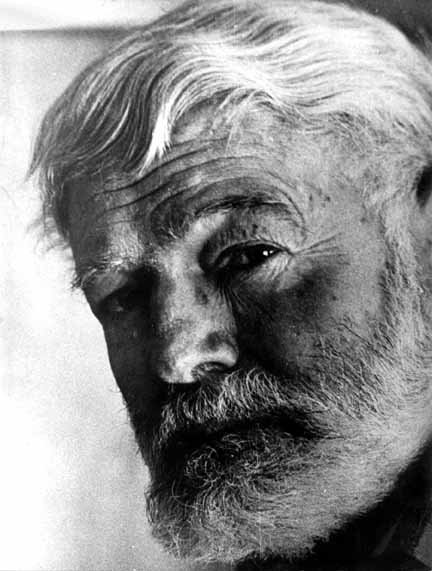
It should be noted that Hemingway was at times neither a gentleman, a good father, nor a proper example of manhood, and no effort will be made here to rewrite history. Yet for all his flaws he represents an enigma of masculinity that so easily captures the imagination. His life was filled with the grand adventures that fill the dreams of many young boys and grown men alike.
Hemingway the Sportsman
During this second safari Hemingway became quite the professional hunter. The local game warden even left him temporarily in charge of the district he was quartered in, commissioning him an honorary game ranger. Hemingway loved the post and spent most of his days sorting out problem lions and elephants at the request of the local farmers.“Going back to Africa after all this time, there’s the excitement of a first adventure. I love Africa and I feel it’s another home, and any time a man can feel that, not counting where he’s born, is where he’s meant to go.”-Papa Hemingway
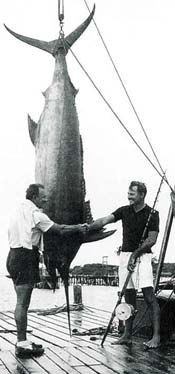
Yet while Hemingway loved hunting, it was when he had a rod in his hand that he was truly successful. It was from the deck of the Pilar that Hemingway famously landed the largest marlin caught to date in 1935, weighing an astonishing 1175 lbs. Truly, his greatest exploit by his own reckoning may very well not have been his literary achievements, but his success with rod and reel. In an interview several years ago, Hemingway’s son recalled that his father’s happiest days were always those spent aboard the boat he made with his own hands, chugging along the Gulf Stream in search of marlin. During his years spent in the Caribbean, he managed to win every single organized fishing contest put on in Key West, Bimini, and Havana, much to the chagrin of the locals.
Hemingway the Boxer
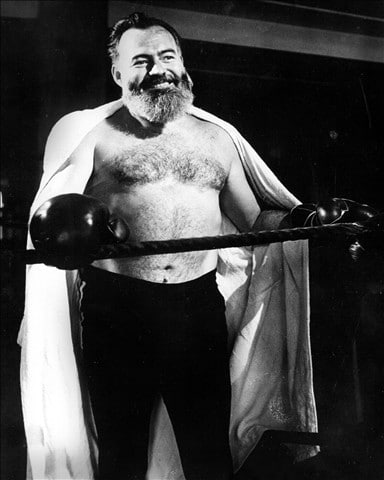 “My writing is nothing, my boxing is everything.”
Hemingway had practiced the sweet science since childhood and at one point was a successful amateur boxer. Following one of his victories in a fishing tournament in Bimini, the locals who had participated became angered at his ability to better fish waters they had fished their entire lives. Seeing an opportunity to combine his passions, he offered the locals a chance to win back their lost money. The terms were simple…go toe to toe with old Papa in the ring for three rounds and win, and the money would be theirs. The first challenger, a man who locals claimed could “carry a piano on his head,” made it only a minute and a half before the 35 year old Hemingway put him on the deck. The next three challengers suffered a similar fate, and Ernest went home with his prize money.-Hemingway in a conversation with Josephine Herbst
Hemingway’s love for boxing was unmatched by his other passions, and he even had a boxing ring built in the backyard of his Key West home, right next to the pool, so that he could spar with guests. Hemingway often dedicated his time not spent writing in Key West to boxing, even refereeing matches at the local arena. In one instance, he was presiding over a match where one fighter was being brutalized by the other. Every time the fighter would get knocked down, however, he would rise again to take more of a beating. Weary of seeing his fighter being abused so, the fighter’s manager, “Shine” Forbes, threw in the towel. Imagine his surprise when the ref picked up the towel and threw it out of the ring! Shine tried two more times to concede the match by throwing in the towel, and on the final try the ref threw it back in his face, which sent Shine over the edge. He climbed through the ropes and took a punch at the ref, effectively bringing an end to the match. Later that evening he was informed that the ref he had thrown a punch at was none other than Ernest Hemingway, local legend and internationally famous author. Embarrassed, Shine went to Hemingway’s home to apologize and was greeted by a smiling Hemingway who, not bothered by the punch thrown at him, had Shine and his friends come in for some sparring in his personal ring. Forging a friendship with the man, Hemingway even had Shine and friends spar for his friends’ entertainment at parties, and would pass a hat around afterwards to collect money for the young fighters.
Hemingway’s love of the sport carried over into the literary world as well. He was known for using boxing analogies in interviews, as well as for attempting to teach the poet Ezra Pound to box during his years in Paris. Several of his short stories reflect his love for the sport, including short stories Fifty Grand and The Battler, and the novel The Sun Also Rises.
Hemingway the Storyteller
It’s no secret that Hemingway could weave a masterful tale behind a typewriter, a fact that is reinforced by a glowing review of Across the River and into the Trees in the New York Times Book Review that labeled him “the most important author since Shakespeare.” But Hemingway was not just a good storyteller on paper. The tales he spun for friends and family captivated everyone within earshot, and were frequently so grand and full of wild incidents that those who listened were often left questioning whether one man could really have experienced so much in a single lifetime. Indeed, many of his tales seemed to stretch the truth, often more than a little. And yet, as his close friend and biographer A.E. Hotchner wrote, he so convincingly imparted his adventures that even the most outrageous yarn seemed feasible. He once recounted a tale to Hotchner as they sat down in an old Paris bar Hemingway frequented:In Hemingway’s biography, Hotchner accepts this and other tales without question, noting that every time he questioned the truth of such a tale, Hemingway would somehow produce photographs or other corroborating evidence to support his claims.“Back in the old days this was one of the few good, solid bars, and there was an ex-pug who used to come in with a pet lion. He’d stand at the bar here and the lion would stand here beside him. He was a very nice lion with good manners – no growls or roars – but, as lions will, he occasionally shit on the floor. This, of course, had a rather adverse effect on the trade and, as politely as he could, Harry asked the ex-pug not to bring the lion around anymore. But the next day the pug was back with the lion, lion dropped another load, drinkers dispersed, Harry again made the request. The third day, same thing. Realizing it was do or die for poor Harry’s business, this time when the lion let go, I went over, picked up the pug, who had been a welterweight, carried him outside and threw him in the street. Then I came back and grabbed the lion’s mane and hustled him out of here. Out on the sidewalk, the lion gave me a look, but he went quietly.” -Papa Hemingway
Hemingway the Nazi Submarine Hunter
Yes, you read that right. For nearly a year during World War II, Ernest Hemingway converted his 38 foot fishing boat Pilar into a Nazi submarine hunting ship in disguise. Coordinating with the Havana branch of the U.S. Office of Naval Intelligence, Hemingway loaded the Pilar down with heavy artillery and small arms alike, all the while maintaining the outward appearance of a standard fishing vessel. He filled the Pilar with friends interested in being a part of the mission, and they carried out daily patrols in the waters off Cuba. The goal was to look like a regular fishing vessel so that a Nazi sub would surface and attempt to board them. The U.S. navy regularly used such tactics, the vessels being known as Q-Ships, in an attempt to draw Nazi subs to the surface. Once a sub surfaced, the Q-Ships would quickly unveil their hidden firepower and hopefully sink the sub. Eventually the FBI took over Caribbean counter-espionage, and while the Pilar and her crew never fired on an enemy sub, it was adventure of the highest sort nonetheless.Hemingway the War Hero
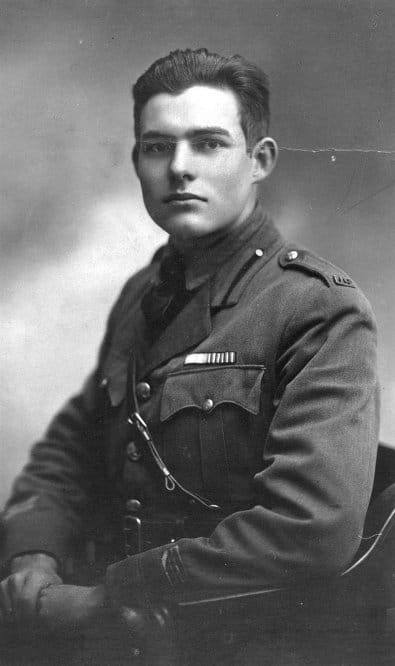
Much later in life, following his exploits as a Nazi submarine hunter, Hemingway left again for Europe to see the action of World War II as a war correspondent. No stranger to action, Hemingway joined the Royal Air Force on bombing raids and followed infantry divisions around Europe wherever the fighting was heaviest. He witnessed the D-Day invasion from a landing craft just offshore and recorded many of the horrors of the war. Hemingway went on to take a much more active role in the combat he was there to document, often assuming the role of soldier himself in direct violation of the Geneva Convention’s guidelines for war correspondents. He once charged up to a cellar known to be filled with German SS, and tossing in a grenade, threw aside his non-combatant designation for the remainder of the war. In the chaos of war, Hemingway allegedly went on to form his own unit, which inexplicably had twice the firepower and alcohol rations of all other units, no doubt Papa’s doing. According to Hemingway himself, he and his unit were the first to enter the city during the Liberation of Paris, when he and his unit retook the Ritz Hotel, and more importantly the Ritz Bar, from Nazi control a full day before the Allied liberation force entered the city! An investigation into his actions during the war by the Army later charged him with several violations of his non-combatant status, including actions such as stripping off his non-combatant insignia and posing as a colonel in order to lead a French resistance group into battle. He was also accused of keeping a virtual armory in his private room, including anti-tank grenades and German bazookas. Hemingway responded to the allegations by noting that any titles given to him by the men were simply signs of affection.
As for the weapons in his room, he claimed he kept them “only for the troop’s convenience.” Several high ranking friends testified on his behalf, and at the end of the investigation he was not only cleared of all charges, but was awarded the Bronze Star for Bravery as a war correspondent. Colonel “Buck” Lanham, a close friend and later a Major General, noted:“After all, anyone who owned a ship in New England was automatically a captain, and all those from Kentucky were colonels from birth.”
“He is without question one of the most courageous men I have ever known. Fear was a stranger to him.”
Hemingway the Survivor
“Man is not made for defeat. A man can be destroyed but not defeated.”Perhaps most unbelievable of all Hemingway’s exploits was the sheer number of potentially fatal diseases and accidents he survived. Aside from the remnants of fragment in his leg left over from the World War I mortar hit, he also bore a bullet wound in his leg. This was the result of a self inflicted gunshot, an accident that occurred while trying to finish off a still thrashing shark he had dragged aboard while shark hunting. While shooting yourself in the leg is by no means the most glamorous thing a man can do, if you must do it, it seems best to do it while shark hunting. Hemingway’s more severe injuries and ailments came later in life. In his later years he survived anthrax, malaria, pneumonia, dysentery, skin cancer, hepatitis, anemia, diabetes, high blood pressure, and several major injuries.
-The Old Man and the Sea
During his last safari in East Africa, he survived not one, but two plane crashes. News of the first crash, deep in the jungles of Uganda, set off reports of his death back home, spawning numerous obituaries which Hemingway would later read daily over his morning coffee with amusement. Following the crash he, his wife, and the pilot were forced to camp overnight in the middle of elephant country, a survival story in itself. The second crash, following just several days after the first, was much more severe, and Hemingway was severely injured as a result. The pilot had been forced to perform an emergency dive to avoid a bird strike, and the plane ground-looped, eventually crashing. The plane burst into flames upon impact, forcing Hemingway to shoulder the door open and help his wife and the pilot to safety. He emerged with a laundry list of injuries, including first degree burns, internal bleeding, ruptured kidney, ruptured spleen, ruptured liver, a crushed vertebra and a fractured skull. Quite the ordeal, yet Hemingway managed a smile for the reporters waiting at his evacuation point, saying to them “my luck, she’s running very good.” Perhaps a bit of an understatement. Not a month later Hemingway was back in action, this time receiving second degree burns on his left hand and face while fighting a wildfire. All this and he lived to tell the tale.
Hemingway the Legend
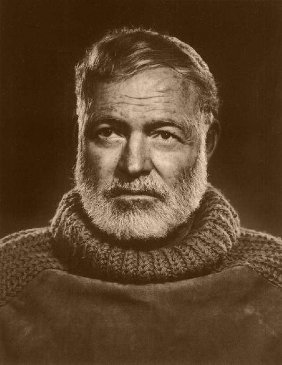
Critics during and after his lifetime tried to paint Hemingway as overly macho, claiming that his public persona was merely an act. Through reading his works and the biographies written about him by close friends, it becomes clear that Ernest Hemingway was not acting. He was, in fact, one of the most genuine men who ever lived. He lived life as he wished, never missing opportunities and never forsaking his passions. Perhaps he is best summed up by actress Marlene Dietrich, a close friend, who commented on his life to his biographer:“In going where you have to go, and doing what you have to do, and seeing what you have to see, you dull and blunt the instrument you write with. But I would rather have it bent and dulled and know I had to put it on the grindstone again and hammer it into shape and put a whetstone to it, and know that I had something to write about, than to have it bright and shining and nothing to say, or smooth and well oiled in the closet, but unused.”-Preface to The First Forty-Nine Stories
Sources:“I suppose the most remarkable thing about Ernest is that he has found time to do the things most men only dream about. He has had the courage, the initiative, the time, the enjoyment to travel, to digest it all, to write, to create it, in a sense. There is in him a sort of quiet rotation of seasons, with each of them passing overland and then going underground and re-emerging in a kind of rhythm, refreshed and full of renewed vigor.”
A. E. Hotchner Papa Hemingway: A Personal Memoir
A&E American Author’s Series Ernest Hemingway: Wrestling with Life
Tuesday, August 20, 2013
Life Is Not Rocket Science - Shri Abdul Kalam
kalam's journey
Life Is Not Rocket Science
Rocket man, president and inspiration for generations of
Indians, Abdul Kalam finally tells his story. Excerpts from his
forthcoming autobiography.
The Boat
Living on the island of Rameswaram while I was growing up, the sea was an important part of our lives. Its tides, the lapping of the waves, the sound of trains passing on the Pamban bridge, the birds that always circled the town and the salt in the air are sights and sounds that will always remain linked with my memories of childhood. Apart from its sheer presence around us, the sea was also a source of livelihood for our neighbours and us. Almost every household had some connection with the sea, whether as fishermen or as boat owners.
My father, too, operated a ferry that took people back and forth between the islands of Rameswaram and Dhanushkodi, which is about 22 kilometres away. I still remember the time when he got the idea for this, and how we built that boat.
Rameswaram has, since antiquity, been an important pilgrimage destination. Rama is believed to have stopped here and built the bridge to Lanka when he was on his way to rescue Sita. The temple of Rameswaram is dedicated to Shiva, and houses a lingam fashioned by Sita herself. Some versions of the Ramayana say that Rama, Lakshmana and Sita stopped here to pray to Shiva on their way back to Ayodhya from Lanka.
People visiting our town would go to Dhanushkodi as part of their pilgrimage. A bath at Sagara-Sangam here is considered sacred. The sangam is the meeting place of the Bay of Bengal and the Indian Ocean. Dhanushkodi is now connected by road and vans take pilgrims there, but way back when I was a child, a ferry was also a good way of reaching the island.
My father, looking to supplement his not very substantial income, decided to start a ferry business. He started building the boat that we needed for this, all by himself initially, right there on the seashore.
Watching the boat come to life from pieces of wood and metal was perhaps my first introduction to the world of engineering. Wood was procured and Ahmed Jalalluddin, a cousin, arrived to help my father out. Every day, I would wait impatiently till I could go to the place where the boat was taking shape. Long pieces of wood were cut into the required shape, dried, smoothened and then joined together. Wood- fires seasoned the wood that made up the hull and the bulkheads. Slowly the bottom, then the sides and the hull began to form in front of our eyes. Many years later, in my work, I would learn how to make rockets and missiles. Complex mathematics and scientific research would be the bedrock of those engineering marvels. But that boat coming up on a seashore, which would take pilgrims and fishermen back and forth...who is to say it was not as important or momentous in our lives then?

Illustrations by Priya Sebastian
|
The Bay of Bengal is hit frequently by cyclones. The months of November and May in particular are dangerous in this regard. I still remember the night of that terrible cyclone vividly. The wind had picked up speed for days, till it became a howling gale. It screamed and whistled in our ears and pulled and hacked at the trees or anything that stood in its way. Soon, a torrential rain started. We had retreated into our houses much earlier. There was no electricity in those days, and the lamps barely managed to stay alive. In that flickering darkness, with the wind working itself into a frenzy, the sound of the rain lashing down outside, we huddled together and waited for the night to pass. My thoughts travelled again and again to the open seas. Was anyone trapped there? What was it like to be in a storm such as this without your mother’s comforting presence close by?
The next morning, after the storm died down, we saw the unbelievable destruction that had been wrought all around us. Trees, houses, plantations were uprooted and devastated. The roads had disappeared under the water and debris blown in by winds that had come in at speeds of over 100 miles an hour. But the worst news of all was the one that hit us like a punch to the stomach. Our boat had been washed away. Now, when I think of that day, I realise that perhaps my father had known this would happen the night before, while we waited for the storm to pass. In his life he had already witnessed so many storms and cyclones. This was just one of them. Yet, he had tried to calm us children down and had made sure we went to sleep without infecting us with his worries. In the light of the morning, seeing his drawn face and the worries lining his eyes, I tried to gather my thoughts. In my mind I mourned our lost ferry boat fiercely. It felt as though something I had made with my own hands had been gathered up and tossed away thoughtlessly.

Illustrations by Priya Sebastian
Cyclones and storms struck us again and again. I even learnt to sleep through them. Many years later, in 1964, when I was no longer living in Rameswaram, a massive cyclone struck. This time, it carried away a part of the landmass of Dhanushkodi. A train that was on Pamban Bridge at the time was washed away, with many pilgrims inside. It altered the geography of the area, and Dhanushkodi became a ghost town, never really recovering its former character. Even today, remnants of buildings stand there as monuments to the 1964 cyclone.
|
Every morning a large pile of newspapers, both in English and Tamil, is delivered to me. During my travels abroad I like to stay in touch with news from India, which I do by going online to read news articles and editorials in different magazines and papers. The wealth of information now available at the click of a finger amazes me. As a person closely involved with engineering and science, the march of technology should not surprise me, but when I juxtapose our lives today with what it was like 70 years ago, in a small south Indian town, the difference is startling even for me.
I was born in the year 1931. When I was about eight, World War II broke out. Britain declared war on Nazi Germany, and despite the Indian Congress’s opposition, India too, as a British colony, was involved in the war. India’s war effort saw a record number of Indian soldiers being deployed in various war zones around the world. Daily life, however, remained fairly unaffected initially, particularly for us in the southern tip of the country. As I have mentioned, Rameswaram in the 1940s was a sleepy little town that came alive with the arrival of pilgrims. The inhabitants were mostly tradespeople or small businessmen.
The town was dominated by the temple, though there was a mosque and a church too. The inhabitants went about their way fairly peacefully, and other than the normal altercations that break out in any town or village, nothing much of importance happened.
The only source of information about the outside world was the newspaper. The agency that distributed newspapers was run by my cousin Samsuddin. Along with Jalalluddin, he was a big influence in my early life. Though he could read and write, Samsuddin was not well travelled, nor highly educated.

Illustrations by Priya Sebastian
Samsuddin’s newspaper distribution agency was the only one in Rameswaram. There were about a thousand literate people in the town, and he delivered newspapers to all of them. The papers carried news about the Independence movement that was heading towards a crescendo at the time. These news items would be read and discussed with great gusto with everyone else.
There would also be news from the war front, about Hitler and the Nazi army. Of course, there were many mundane matters too, like astrological references or bullion rates, which were consulted with utmost interest. The Tamil paper, Dinamani, was the most popular of all these papers.
The way the papers reached Rameswaram was quite unique. They came by morning train and were kept at Rameswaram station. From there, they had to be collected and sent to all the subscribers. This was Samsuddin’s business and he managed it effortlessly. However, as World War II raged, we no longer remained isolated from the world, and it affected my life and the newspaper delivery business in a strange new way.
The British government had placed a number of sanctions and rations on goods. Something like a state of emergency now prevailed in the country. Our large family felt the difficulties acutely. Food, clothes, the needs of the babies of the household, all became difficult to procure and provide for. In our family, there were five sons and daughters, as well as my father’s brothers’ families. My grandmother and mother had to stretch every resource to the utmost to keep everyone fed, clothed and in good health.
|
However, my new job had to be fitted into my regular routine. My studies and school had to continue as before, and the delivery business had to be accommodated amidst all these other activities. Among my siblings and cousins, I had shown an early aptitude for mathematics. My father had arranged for me to take tuitions from our mathematics teacher. However, my teacher had a condition that I, along with the four other students whom he had accepted, needed to reach his home at dawn after having taken a bath. So for a year, which was the duration of the tuition, I started my day while it was still dark outside, with my mother shaking me awake. She herself would have risen before me and got my bath ready. She would then help me bathe and send me on my way to my teacher’s home. There I would study for an hour and return by 5 am. By then my father would be ready to take me to the Arabic School nearby, where I learnt the Quran Sharif.

Illustrations by Priya Sebastian
I then picked up the bundles, divided them up into batches according to the neighbourhoods in which the papers had to be distributed and off I went. For about an hour I tore around Rameswaram, delivering the papers to everyone. Soon I began to identify people by the papers they read. Many would be waiting for me, and there would always be a friendly word or two. Some would tell me fondly to hurry back home so I would not be late for school! I think most enjoyed being handed their papers by a cheerful eight-year-old.
Our town being on the east coast, by the time the work was over at 8 am, the sun would be high up in the sky. Now I headed back home, where my mother waited with breakfast. A simple meal would be served, but how hungry I was usually! My mother made sure I ate every morsel before sending me out to school. But my work did not end there.
In the evening, after school was over, I would do the rounds of Samsuddin’s newspaper customers again, collecting their dues from them. Then I would meet him, so he could work out the accounts of the day.
|
When I Failed
In my life, which has been long and eventful, I have seen great heights of success. I have been part of ventures that have contributed to the growth of our nation in the field of science and technology; I have also had the privilege of occupying the highest office in the country. There are many achievements to look back upon—some of my own doing and some where I had the privilege of being part of teams that were immensely talented. Yet, I firmly believe that unless one has tasted the bitter pill of failure, one cannot aspire enough for success. I have seen both sides of the coin and have learnt life’s toughest lessons when I have stared into the pit of despair that failure brings with it. These lessons are well worth recounting and remembering, as they have helped me work my way through many difficult situations.
|

Illustrations by Priya Sebastian
That day I learnt two lessons: a teacher who has his or her student’s progress in mind is the best possible friend, because the teacher knows how to make sure that you excel. And second, there is no such thing as an impossible deadline. I have worked on many tough assignments, some of which had the country’s top leaders watching over my work, but the assurance I gained in my capabilities at MIT thanks to Professor Srinivasan helped me later in life too.
|

Illustrations by Priya Sebastian
I first halted in Delhi for my interview at DTD&P. I was confident and the interview was an easy one, not requiring me to push the boundaries of my knowledge too far. I spent a week in Delhi and then proceeded to Dehradun for my interview at the Air Force Selection Board. Here, I should mention that at the time, as a young man in my early 20s, I was just beginning to understand how to conduct myself in the wider world. When I had first moved from Rameswaram to the bigger cities for my studies, I was a shy, tongue-tied boy. I had to work hard to develop some assertiveness in my personality. I did this by trying to communicate with different people from all kinds of backgrounds. It was not easy, of course, and there were many moments of frustration and disappointment. However, by the time I finished my studies and headed out to look for a job, my personality was better developed and I was able to articulate my thoughts well enough in English and Tamil.
To return to my interview at the Air Force Selection Board, as I started answering the queries put forth to me, I realised that along with qualifications and engineering knowledge, they were also looking for a certain kind of ‘smartness’ in the candidate. Physical fitness and an articulate manner were what they were seeking. I gave it my best. I had wanted this job for so long and so deeply that I was determined yet anxious, confident and at the same time tense. Finally the results were announced. I had stood ninth in a batch of twenty-five. There were only eight places available. I had failed to realise my dream of becoming an air force pilot.
I still remember the ache in my heart as I attempted to make sense of what had happened. When a dearly held desire begins to break up, one can feel nothing but despair and emptiness as one tries to come to terms with the end of a dream. I could not bear to be indoors after seeing the result. I had to go out for air and be in the open, because all around me the walls seemed to close in. I walked around for a while till I reached the edge of a cliff. I stood there looking down at the shimmering waters of a lake and wondered what I should do next. Plans needed to be changed and priorities reassessed. I decided to go to Rishikesh for a few days and seek a new way forward.
|
In this way I started my working life. Like me, I am sure almost every person who sets out with a goal has had to face unexpected obstacles. We’ve had to rethink our goals, reorient our paths. Each setback teaches us a new facet of life and something about our own personalities. When we tackle obstacles, we find hidden reserves of courage and resilience we did not know we had. And it is only when we are faced with failure do we realise that these resources were always there within us. We only need to find them and move on with our lives.
***
My Favourite Books- Light from Many Lamps: Edited by Lillian Watson; contains the writings/inspiring stories of many authors. The book has brought me solace in my hours of sadness and uplifted me when I needed advice.
- Thirukkural: Written by Thiruvalluvar over 2,000 years ago, it's a collection of 1,330 rhyming Tamil couplets or aphorisms (kural). To me, it's provided a code of conduct for my life. It is a work that truly elevates the mind.
- Man the Unknown by Alexis Carrel: His description of the human body—how it is an intelligent, integrated system—is explained brilliantly. This work should be read by everyone, especially those studying the medical sciences.
- The Gita: It says, ‘See the flower, how generously it distributes perfume and honey. When its work is done, it falls away quietly. Try to be like it, unassuming despite all its qualities.’
- The Holy Quran: I have worked with many brilliant engineers/leaders. The words from the Quran ring in my ears when I think of them: ‘Light upon light. Allah guides His light to whom He will.’
Subscribe to:
Posts (Atom)